Few cars are as beloved as the original Citroën 2CV. Launched in 1948 to put rural France on wheels, the humble “Deux Chevaux” stayed in production until 1990 and became a symbol of simple, affordable, joyful motoring. Now it is coming back. At the Paris Motor Show, Citroën unveiled the 2 CV Concept, an all-electric reinterpretation of the icon that previews a production model due by 2028, with a target starting price of around €15,000.
If Citroën hits that price, the new 2CV could become one of the most affordable new electric cars in Europe, and a rare example of a legacy brand fighting back against low-cost Chinese rivals with charm rather than size.
Small, Light and Built for the City
The 2 CV Concept measures 3.76 meters long, slightly shorter than the original. Citroën is targeting a weight of around one tonne, very light for a modern electric car. Keeping the weight down allows the use of a smaller, cheaper battery while still delivering usable range, which is central to the car’s affordable mission.
In Citroën’s lineup, the new model will sit between the tiny Ami electric quadricycle and the C3 supermini. It has been designed to comply with the European Union’s upcoming “E-Car” regulations for small, affordable electric vehicles, and it will be manufactured in Europe.
Citroën has not yet released power, battery, or range figures. Industry observers expect a modest battery suited to urban and suburban driving, in line with other small city EVs.
A Design Full of Smiles
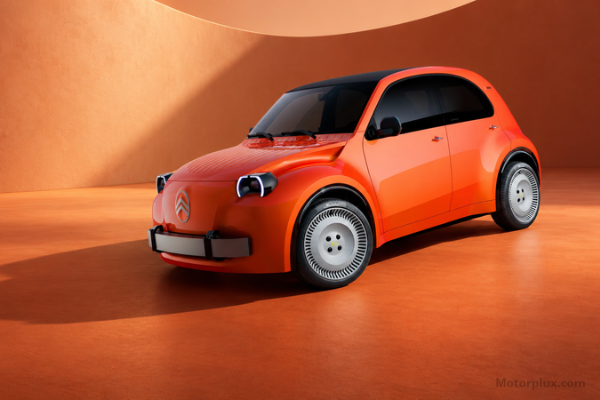
The concept captures the spirit of the original without copying it. The silhouette is instantly recognizable, with round headlamps that stand apart from the bodywork, a sculpted bonnet, exposed windscreen wipers, and a curved, flowing roofline. Like the original, it features a large fabric sunroof that rolls back to open the cabin to the sky.
The concept is finished in a vibrant “Infra Red” orange with yellow and red highlights and rides on 18-inch steel wheels fitted with Michelin tires featuring a special chevron tread pattern. At the rear, a black tailgate stretches down to the bumper, flanked by LED lights and three horizontal stripes.
An Interior Unlike Any Other
Inside, Citroën has rethought the cabin entirely. There is no traditional dashboard. Instead, a cylinder in front of the driver holds a single-spoke steering wheel, a control lever, a paddle-style gear selector, and Citroën’s Smart Vision display. An 8-inch square touchscreen uses playful comic-book-style graphics.
The seats use Citroën’s Advanced Comfort technology and are trimmed in a yellow tartan-inspired fabric, with beige accents that recall vintage Bakelite. A removable “Radioën” radio doubles as a portable speaker, and a removable storage basket replaces the usual center console.
The design team also hid plenty of playful heritage details throughout. The brake and accelerator pedals feature a tortoise and a rabbit. The door pockets include shapes designed to hold eggs, a nod to the legend that the original 2CV was engineered to cross a plowed field without breaking a basket of eggs. Even the horn and the start-up sound echo the original car, and small markings on the windscreen read 48, 90 and 26, marking 1948, 1990, and 2026.
“Reinventing the 2 CV isn’t about replicating a car from the past,” said Citroën CEO Xavier Chardon, explaining that the goal is to recapture what made the original so unique.
A Bigger Mission
The return of the 2CV comes at a critical moment for Europe’s car industry. Buyers have been asking for affordable electric cars, and Chinese manufacturers have moved quickly to fill that gap. At the Paris Motor Show, European brands responded with a wave of small, accessible models, from the reborn Renault Twingo to the second-generation Dacia Spring and the Smart #2.
The 2CV adds something different: personality. Rather than competing on price alone, Citroën is betting that a car with character, comfort, and a strong emotional connection can win buyers’ hearts.
Why It Matters
The original 2CV brought freedom of movement to millions of people who had never owned a car. Its electric successor aims to do something similar for a new generation, making clean, simple, and affordable mobility accessible to more drivers. If the production version stays close to this concept, 2028 could see one of the most charming electric cars ever built arrive at a price many families can afford.