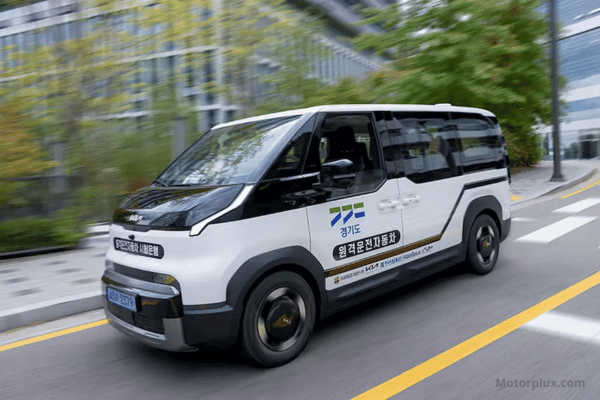
Imagine booking a rental vehicle on your phone and having it arrive at your door with nobody inside. That is exactly what Kia is now testing in South Korea. The automaker has launched what it describes as a first-of-its-kind car-sharing service using remote driving technology and its PV5 electric van. The pilot program began operating on October 15 in Pangyo, a technology hub in Gyeonggi Province, and will run until the end of 2026.
How It Works
The service is designed to remove one of the biggest hassles of car sharing: getting to the vehicle and returning it.
Users reserve a PV5 through a dedicated smartphone app. Instead of walking to a parking lot to pick it up, the van is delivered to the requested location by a remote driver, a trained operator who controls the vehicle from a remote center using 4G and 5G mobile networks. When the van arrives, the customer gets in and drives it normally.
When the trip is over, the user simply parks the van wherever they choose within the service area. A remote driver then takes over again and returns the vehicle to its garage, ready for the next customer.
It is important to note that this is not self-driving technology. A human operator is in control at all times when the vehicle is moving without a driver on board, which allows the system to be deployed today while autonomous driving technology continues to mature.
A Large Partnership
Kia is leading the project and supplying the PV5 vans. It is working with a consortium that includes SUM, which provides the remote driving solution, Mobiops, which handles service operations, and the Korea Road Traffic Authority, which conducts regulatory reviews. The project is also supported by Gyeonggi Province, telecom company KT, and several other partners.
To make the pilot possible, Kia received a special exemption under a regulatory sandbox from South Korea’s Ministry of Land, Infrastructure and Transport. Regulatory sandboxes allow companies to test new technologies under real-world conditions with government oversight before permanent rules are established.
The project builds on earlier steps. In November 2025, Kia joined a remote driving consortium with car-sharing company Socar, KT, and SUM, and in July 2026, it signed a memorandum of understanding with KT and SUM to launch the service within a year. The pilot arrived on schedule.
Why the PV5?
The PV5 is the first model in Kia’s Platform Beyond Vehicle (PBV) lineup, a family of electric vans designed to be highly adaptable for different uses, from passenger transport to deliveries and mobile workspaces. Its spacious interior and electric powertrain make it well suited for shared mobility services in cities, where demand for flexible transport is growing.
Testing in the Real World
The pilot will evaluate both the remote driving technology and how the service performs in real-world conditions, including how customers use it, how quickly vehicles can be delivered, and how the system handles everyday traffic. Kia plans to expand the service in 2027 based on the results.
The Benefits
Remote-delivered car sharing could make shared vehicles far more convenient. Customers would no longer need to search for a parked car or return it to a specific location. Operators could reposition vehicles to where demand is highest, improving efficiency and reducing the number of idle vehicles. And because the PV5 is electric, the service produces no tailpipe emissions in busy urban areas.
A Glimpse of Future Mobility
Remote driving could also benefit other services in the future, such as delivering rental cars to airports, moving vehicles between parking facilities, or bringing cars to service centers for maintenance. Each of these tasks currently requires a person to physically drive the vehicle, and remote operation could make them faster and more efficient.
Why It Matters
Kia’s pilot is a practical example of how new technology can improve everyday mobility before fully autonomous vehicles are ready. By combining electric vehicles, mobile networks, and trained remote operators, the service delivers some of the convenience people expect from self-driving cars, with a human still in control. If the pilot succeeds, the idea of a rental car that comes to you could soon spread to more cities.