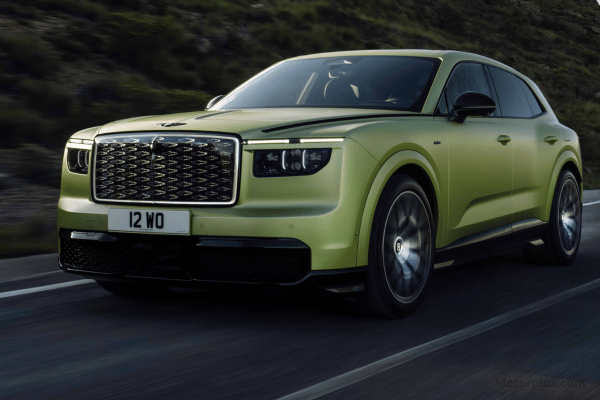
After 107 years of building some of the world’s most exclusive combustion-powered cars, Bentley has finally entered the electric era. The Torcal, unveiled at an event in London in late September, is the British luxury brand’s first fully electric vehicle, its fourth model line, and, perhaps surprisingly, its cheapest car to date. It is a bold, carefully calibrated bet that wealthy buyers want zero-emission driving without giving up what makes a Bentley feel like a Bentley.
A different kind of entry-level Bentley
The Torcal is a compact luxury SUV, about five meters long, making it the shortest four-door Bentley ever built. It sits below the Bentayga in the lineup and is explicitly aimed at drawing in younger buyers and people who have never owned a Bentley before. In the UK, the core model starts at £173,300 (roughly $230,000), while the more powerful S version begins at £199,300. Early US estimates have ranged from around $200,000 to $250,000, with American sales expected to begin next year. That makes it far more approachable than anything else the company sells, and a fraction of what rivals such as Ferrari are charging for their first EVs.
Bentley’s chief executive, Frank-Steffen Walliser, told Reuters the company always intended the Torcal to be a Bentley first and an EV second. In his view, customers are not asking for a completely different kind of car just because it happens to be electric, and the Torcal’s design reflects that philosophy.
Serious performance, deliberately tamed
Both versions use a dual-motor setup. The core model produces about 810 horsepower, while the S pushes that to 876 horsepower and 996 lb-ft of torque, the most of any Bentley ever built. With launch control engaged, the S can reach 60 mph in 2.8 seconds. Interestingly, Bentley chose to cap the car’s acceleration, noting that most of its customers find truly violent acceleration uncomfortable. The company describes the S as delivering performance that is accessible without being absurd, a notable contrast with the four-figure horsepower arms race playing out elsewhere in the EV world.
Power comes from a 113 kWh, 800-volt battery pack (about 108 kWh usable), good for up to 375 miles of WLTP-rated range. Charging is where the Torcal really stands out: it can accept up to 400 kW from a DC fast charger, enough to take the battery from 10 to 80 percent in under 20 minutes, or add roughly 100 miles of range in about seven minutes. The battery is covered by a 10-year, 100,000-mile warranty. Bentley acknowledges that 375 miles is less than many cheaper EVs, but says it matches what its customers actually need, and that chasing a 500-mile figure would have compromised the car’s driving dynamics.
Familiar underpinnings, unmistakable character
Underneath, the Torcal shares much of its architecture with Porsche’s new electric Cayenne, giving it a proven, high-performance foundation within the Volkswagen Group. But Bentley has worked hard to make sure it doesn’t feel like a re-badged Porsche. The interior leans heavily into the brand’s traditional craftsmanship, with wool upholstery, crystal-inspired reflections, and a curved display. The Torcal also introduces the company’s redesigned emblem for the first time.
One of the most talked-about details is how Bentley has handled sound. To replace the rumble of its signature V8, the car plays what the company calls a Dynamic Symphony soundtrack, built from recordings of real musical instruments rather than synthesized engine noise. It is an unusual approach, but one that fits a brand that has always treated the experience of driving as part of the product.
On the practical side, the Torcal offers a 460-liter trunk plus an additional 90-liter front storage compartment, making it more usable than its sporty proportions might suggest.
Built in Crewe after a major investment
Bentley is building the Torcal at its historic factory in Crewe, England, which has undergone a £350 million (about $465 million) transformation so it can produce electric and combustion models in sequence on the same site. Production is scheduled to begin before the end of the year. The Torcal arrives only weeks after its closest competitor, the new electric Range Rover, setting up one of the most interesting rivalries in the luxury SUV segment.
Why this launch matters
The Torcal is, in many ways, Bentley’s most important launch in years. It is the brand’s first real test of whether its customers are ready to go electric, and it is being asked to do double duty: proving that a Bentley can be an EV without losing its identity, and bringing in a new generation of buyers at a lower entry price than the company has ever offered. Bentley has not yet announced a second EV, which means the Torcal’s reception will likely shape the brand’s electric strategy for years to come.
For the broader industry, the Torcal is a signal that even the most traditional luxury marques are now committing real money to electrification, even as some mainstream automakers rethink their own EV timelines. If the formula works, with exceptional charging speed, restrained but potent performance, and an interior that feels unmistakably Bentley, it could offer a template for how heritage brands make the leap into the electric future without alienating the people who made them famous in the first place.