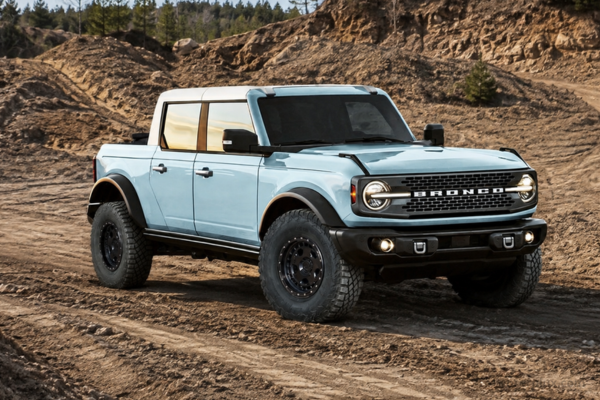
Ford is preparing to revive one of its most persistent “what if” projects: a pickup truck built on the Bronco platform. According to a report from Automotive News citing people familiar with the automaker’s future product plans, the Bronco pickup is part of a broader strategy at Ford to stretch its most popular nameplates — Bronco, Mustang, and Transit among them — into full families of vehicles rather than single models.
A truck a decade in the making
The modern Bronco returned in July 2020 as a body-on-frame SUV built to compete with the Jeep Wrangler, and a pickup derivative was seriously considered before the launch of the current generation. Ford ultimately shelved the idea in 2021, at a time when supply chain disruptions made it hard enough to keep up with demand for the SUV itself, let alone add another body style. Five years later, with those constraints eased and Ford rethinking its broader product lineup, the pickup is reportedly back on the table, with a possible arrival “near the end of the decade” — around 2030, according to the report.
Before the truck arrives, Ford is expected to introduce a hybrid version of the Bronco SUV, targeted for the 2027 or 2028 model year, using a self-charging hybrid powertrain alongside the existing turbocharged 2.3-liter four-cylinder and 2.7-liter V6 engines. Neither the hybrid nor the pickup is expected to require an all-new generation of the Bronco; both would likely arrive as part of ongoing running changes to the current model, which isn’t due for a full redesign until around 2029.
Building subbrands out of best-sellers
The Bronco pickup is only one piece of a larger shift in strategy. Ford is also reportedly working on a four-door Mustang — sometimes referred to as the “Mach 4” — which it has already shown to dealers, extending a nameplate that already spans the traditional Mustang coupe and the Mustang Mach-E electric crossover. A smaller version of the Transit van is also said to be in the pipeline. Taken together, the moves point to a company betting that its strongest brand names, not just its strongest individual models, are what will carry it through a period of shifting consumer demand.
That same logic extends to Lincoln. Ford’s luxury arm is reportedly planning a rugged, Bronco-based off-roader of its own, positioned as a premium alternative starting north of $70,000 — roughly half the price of a Mercedes-Benz G-Class — with production tentatively expected to begin in late summer 2029 at the Michigan Assembly Plant in Wayne, alongside its Bronco sibling.
Where the Bronco pickup would fit
If built on the standard body-on-frame Bronco platform, a Bronco pickup would share its ladder-frame T6 architecture with the Ford Ranger, which is assembled at the same Michigan plant. That would position the new truck between Ford’s smaller offerings — the compact Maverick and the upcoming midsize electric Fathom pickup, confirmed to start near $30,000 — and the full-size F-Series lineup, giving Ford a rugged, off-road-focused midsize option to challenge the Jeep Gladiator directly.
Making room for the new truck could also reshuffle Ford’s manufacturing footprint. Reports suggest that Ranger production may eventually shift to Ford’s Tennessee Truck Plant, timed to a next-generation Ranger expected around 2029, which would free up capacity at Michigan Assembly for the Bronco pickup and the new Lincoln off-roader.
Part of a broader pivot away from expensive EVs
Automotive News frames the wave of new gas and hybrid models as a “product blitz” tied to Ford’s broader retreat from costly, high-end electric vehicles. The company has already confirmed plans to refresh roughly 80 percent of its North American lineup before 2029, and its next-generation electric strategy is centered on smaller, more affordable vehicles — including the Fathom pickup — built using a new manufacturing process, rather than larger, pricier EVs.
Still unofficial, but consistent with Ford’s direction
Ford has not publicly confirmed the Bronco pickup, and the timeline — potentially a decade after the SUV’s relaunch — leaves plenty of room for the plan to shift again before it reaches production. But the strategy behind it lines up with moves the company has already made publicly: turning Mustang into a multi-vehicle family, doubling down on hybrids as EV demand cools, and using its most recognizable names to anchor new products rather than launching unfamiliar ones from scratch. If it goes ahead as described, the Bronco pickup would give Ford a direct answer to the Gladiator and mark the most significant expansion of the Bronco family since the Bronco Sport arrived alongside the SUV in 2021.