In one of the more surprising strategic shifts from a major automaker this year, Toyota has fully redesigned its three-row Highlander SUV for its fifth generation — and dropped gas and hybrid power entirely. The 2027 Highlander arrives as an all-electric vehicle, marking Toyota’s first EV to be assembled in the United States and putting the brand into direct competition with the Hyundai Ioniq 9 and Kia EV9 in the three-row electric SUV segment.
A “re-imagining,” not a spin-off
Toyota has been careful about how it frames this shift. Rather than positioning the electric Highlander as a separate model sitting alongside a continuing gas version, the company describes it as a genuine reinvention of the nameplate itself — this is the fifth-generation Highlander, full stop, not an EV variant bolted onto an existing lineup. The move comes after years of the Highlander losing ground internally to Toyota’s own larger, roomier Grand Highlander, as well as to the immensely popular RAV4 — both of which had been drawing shoppers away from the traditional Highlander. Rather than let the nameplate keep fading, Toyota opted to reposition it entirely around electric power. The larger Grand Highlander will continue on with its existing gas and hybrid powertrains, giving Toyota’s three-row lineup a clear electric option and a clear combustion option rather than two overlapping gas SUVs.
What’s actually changed under the skin
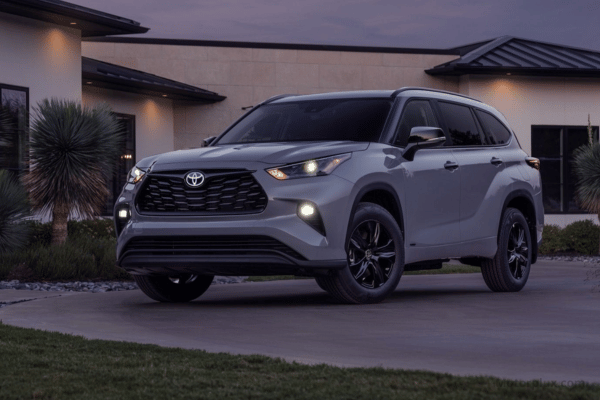
The redesigned Highlander grows larger than its gas-powered predecessor and adopts sharper, bolder styling, with L-shaped daytime running lights, a grille-less front end, a ridged hood, and a chunky front fascia with large horizontal air vents. Inside, a substantial 14-inch touchscreen anchors the cabin, running the same infotainment software that debuted on the redesigned RAV4.
Toyota is offering the new Highlander in two well-equipped trims, XLE and Limited, each paired with a choice of two battery packs — a 77 kWh unit and a larger 95.8 kWh pack — giving buyers flexibility between cost and maximum range. Preliminary figures point to up to 320 miles of range and 338 horsepower, with seating for seven, putting the Highlander in close competitive range with the Ioniq 9 and EV9 on paper. The SUV also supports fast-charging from 10 to 80 percent in around 30 minutes under ideal conditions at a Level 3 DC charging station, and comes standard with a dual-voltage charging cable that works with either 120-volt or 240-volt outlets.
One feature likely to appeal well beyond typical EV buyers is vehicle-to-load capability, letting the Highlander’s battery pack supply power outward — useful for running tools or camping gear, or as backup power for a home during an outage. It’s the kind of practical, real-world feature that helps make the case for going electric to shoppers who might otherwise be on the fence.
Built in America, powered by American-made batteries
Perhaps the most significant part of this launch isn’t the styling or the spec sheet — it’s where the Highlander will actually be built. The new SUV will roll off the line at Toyota’s long-running manufacturing facility in Georgetown, Kentucky, making it the first battery-electric Toyota assembled on US soil. Its battery packs will be sourced domestically as well, drawing from Toyota’s newly opened $13.9 billion battery plant in Liberty, North Carolina, supplemented by an additional supplier partner.
That combination — a US-assembled vehicle running on domestically produced batteries — gives Toyota a genuinely different supply chain story than most of its EV competitors, many of which still rely more heavily on batteries sourced from Asia or Europe. It also builds directly on Toyota’s broader pattern of US manufacturing investment; the Georgetown plant had already been the subject of a separate, smaller November 2025 investment of $204.4 million tied to expanding hybrid vehicle production, showing a facility that’s been steadily gaining new responsibilities across Toyota’s electrified lineup rather than just adding EV assembly as an isolated, one-off decision.
Timing and what’s still unknown
Toyota expects Highlander sales to begin in late 2026, continuing into early 2027 — meaning the wait for interested shoppers is now measured in months rather than years. Pricing hasn’t been announced yet, and it’s a genuinely open question worth watching: rival three-row electric SUVs like the Ioniq 9 and EV9 start in the mid-$50,000s and run well past $70,000 depending on trim, and where Toyota lands within or below that range will heavily influence how much of the segment it can capture. Given the electric Highlander is expected to command a real premium over the previous gas and hybrid versions, aggressive pricing would meaningfully strengthen its competitive position.
Why it matters
Toyota has generally moved more cautiously into full battery-electric vehicles than some of its rivals, leaning heavily on hybrids as its primary electrification strategy for years. The decision to convert one of its best-known, highest-volume nameplates entirely to electric power — rather than simply adding another standalone EV to the lineup — signals a notable escalation in how seriously Toyota is now taking the three-row electric SUV segment. Combined with a US assembly plant and domestically sourced batteries, the new Highlander gives Toyota a genuinely competitive, homegrown answer to two of the more established players in the category.