BYD has officially launched the Sealion 08 in China, and the flagship SUV arrives as the first model in the automaker’s lineup to offer its new second-generation Blade Battery across both plug-in hybrid and fully electric variants. The dual-powertrain rollout gives Chinese buyers a rare direct choice between EV and PHEV versions of the same flagship SUV, both benefiting from the same underlying battery advance on day one.
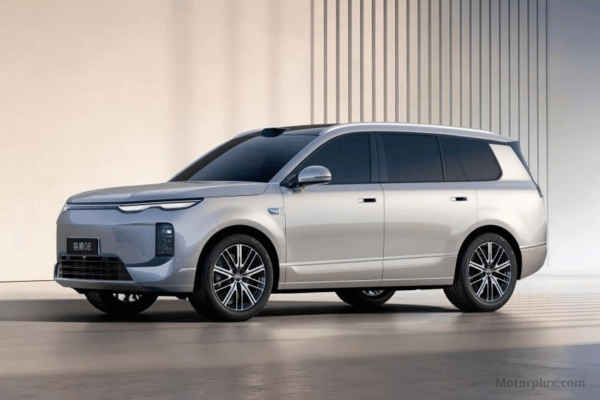
A flagship built to showcase BYD’s newest battery
The second-generation Blade Battery is the headline story here. BYD has spent years refining the original Blade Battery’s cell-to-body design, which integrates battery cells directly into the vehicle’s structure for improved safety and packaging efficiency, and the Sealion 08 is the first model to bring the updated version to market in both electrified formats. On the EV side, the Sealion 08 pairs the new battery with up to 115 kWh of capacity, delivering a CLTC-rated range of up to 900 km (roughly 559 miles) — a genuinely long-range figure even by the standards of China’s fast-moving EV market. Earlier reporting on the SUV’s specifications had already flagged a substantial 810 kg battery pack as the mechanism behind that range figure, underscoring just how much of the Sealion 08’s engineering effort went into maximizing usable capacity within the vehicle’s structure.
Serious performance to match the range
BYD isn’t positioning the Sealion 08 purely as an efficiency play. Earlier technical reveals showed the SUV packing up to 643 horsepower, giving the flagship genuine performance credentials alongside its long-range capability — a combination that’s becoming increasingly common among China’s top-tier EV makers as battery energy density and motor output both continue climbing. The Sealion 08 name places it above the smaller Sealion 07 in BYD’s crossover lineup, positioning it as a full-size, range-topping SUV rather than a mainstream volume model.
Two powertrains, one platform
What makes the Sealion 08’s launch particularly notable is BYD’s decision to offer both EV and PHEV versions from day one, built around shared underlying battery technology rather than treating the two powertrains as separate engineering efforts. That approach lets BYD address two very different buyer priorities — maximum electric range and zero tailpipe emissions on one hand, versus the flexibility and reduced range anxiety of a plug-in hybrid on the other — without splitting its most advanced battery technology between only one option. For a flagship model meant to showcase BYD’s engineering capability, offering the second-generation Blade Battery across both variants sends a clear signal that the company sees the advance as core technology, not a feature reserved for a single configuration.
Part of a broader flagship push
The Sealion 08’s launch follows a lengthy public rollout that began with camouflaged prototype images and interior reveals earlier in 2026, building anticipation well ahead of the official September 2 launch date. That drawn-out reveal cycle — increasingly common among Chinese automakers launching flagship models — gave BYD months to generate interest and gather feedback before finalizing pricing and trim details for the Chinese market.
The Sealion 08 also arrives as BYD continues expanding its Sealion and Seal nameplates across multiple body styles and price points, a strategy that mirrors how legacy automakers use trim ladders and nameplate families to cover more of the market with shared underlying engineering. With a second-generation battery now proven across both an EV and a PHEV variant of the same vehicle, BYD has effectively field-tested its newest core technology across two very different use cases simultaneously — a pattern likely to inform how the company rolls the same battery generation out across other models in its lineup going forward.
Why it matters beyond China
For the broader EV market, the Sealion 08’s dual-powertrain launch is a useful data point in how quickly Chinese automakers are able to iterate on core battery technology and deploy it across multiple vehicle configurations at once. Where many legacy automakers treat a major battery generation change as a multi-year, single-model rollout, BYD’s approach with the Sealion 08 suggests a faster, more parallel deployment strategy — one that could let the company spread the benefits of its second-generation Blade Battery across its lineup considerably faster than a more traditional, sequential rollout would allow. As BYD continues expanding its international footprint, that speed of iteration is exactly the kind of competitive advantage Western and legacy automakers are watching most closely.