Ford has officially named and priced its next affordable electric pickup: the Fathom, a midsize truck starting at $28,350 before destination charges, positioning it as one of the cheapest electric vehicles set to reach the US market from any major automaker. Ford CEO Jim Farley has described the project in strikingly ambitious terms, calling it nothing short of a “Model T moment” for the company.
An answer to mounting pressure from China
Ford’s motivation for the Fathom is explicit and unusually candid for a major automaker: the truck exists specifically to compete with the wave of low-cost electric vehicles coming out of China, which have put real pressure on legacy automakers’ ability to compete on price in electrified segments worldwide. Rather than trying to out-spec Chinese EV makers on range or luxury features, Ford’s approach with the Fathom is to match their fundamental advantage — cost — using a from-scratch engineering approach built specifically around affordability rather than adapted from an existing, pricier platform.
That strategy stands in sharp contrast to Ford’s first attempt at a mainstream electric truck. The F-150 Lightning launched in 2022 at $40,000, with Ford expecting strong volume given the strength of the F-150 name. Instead, by 2023 the starting price had climbed to nearly $60,000, and sales never topped 33,510 units even in their best year; Ford ended F-150 Lightning production in December 2025. The Fathom represents a deliberately different bet — smaller, simpler, and priced to compete directly with gas-powered trucks rather than positioned as a premium alternative.
Built on an entirely new, cost-focused platform
The Fathom is the first vehicle built on Ford’s new Universal Electric Vehicle (UEV) platform, an architecture the company designed from the ground up around cost reduction rather than adapting from an existing gas or hybrid platform. According to Ford, the UEV platform reduces the total number of parts required compared with a typical Ford vehicle program by 20 percent, and the manufacturing process built around it eliminates 40 percent of the process workstations used in current production. Fewer parts and a simplified assembly process translate directly into lower manufacturing costs — savings Ford is passing through to the sticker price rather than banking as additional margin.
The truck will be built using a new “assembly tree” manufacturing method at Ford’s Louisville Assembly Plant, and to keep battery costs down, Ford is using lithium iron phosphate (LFP) chemistry — a less expensive, cobalt-free battery technology that trades some energy density for meaningfully lower material costs. The traction battery runs on a 400-volt architecture, a step down from the 800-volt-plus systems increasingly common among premium EVs, but Ford says that choice was deliberate for this specific use case rather than a compromise forced by cost alone.
What you actually get for $28,350
Despite its budget positioning, the Fathom isn’t a stripped-down, bare-bones work truck. Ford has confirmed seating for five adults, a front trunk (“frunk”) in addition to the pickup bed, and a large, high-resolution touchscreen — features aimed at making the Fathom a genuine everyday vehicle rather than a specialty commercial tool. Every Fathom will also be capable of running Ford’s BlueCruise hands-free highway driving assistant, a feature typically reserved for pricier trim levels on other vehicles, and the truck includes bidirectional power capability along with a digital car key.
In terms of size, the Fathom occupies roughly the same compact footprint as Ford’s own Maverick — despite Ford describing it as a midsize truck — with a short hood, upright cabin, and practical bed dimensions rather than the imposing scale of a full-size F-150. Ford says the Fathom will actually offer more interior passenger volume than a Toyota RAV4, a genuinely useful comparison point for shoppers weighing it against a compact SUV rather than a traditional truck.
Pricing that lines up neatly against Ford’s own lineup
The $28,350 starting price puts the Fathom almost exactly on top of Ford’s own gas-and-hybrid Maverick, which starts at $28,145 — meaning Ford is essentially offering shoppers a genuine electric option at the same price point as one of its most successful recent vehicles, rather than asking buyers to pay a premium to go electric. Add the standard $1,595 destination and delivery charge, and the base Fathom lands just under $30,000 — hitting a price threshold Ford has publicly promised for its next generation of EVs for some time.
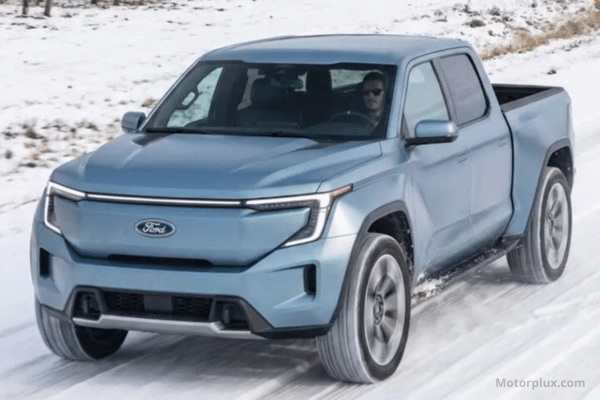
Preorders for the Fathom are set to begin in early 2027, with customer deliveries expected later that year. Ford has not yet revealed what the production vehicle will actually look like, leaving the truck’s final exterior design as one of the more closely watched remaining questions before launch.
Why it matters beyond the price tag
The Fathom is Ford’s clearest public statement yet that it believes profitable EVs require rethinking the entire vehicle from the ground up, rather than simply electrifying an existing platform. Ford has said its goal for the UEV platform is for every vehicle built on it to become profitable within a year of launch and genuinely cost-competitive with EV leaders in China and with Tesla — a considerably more aggressive financial target than most legacy automakers have set for their electric lineups. If the Fathom hits its promised price and volume targets after the F-150 Lightning’s rocky run, it would mark a significant proof point for Ford’s broader bet that affordability, not additional range or luxury features, is what will ultimately determine which EVs actually sell in volume.