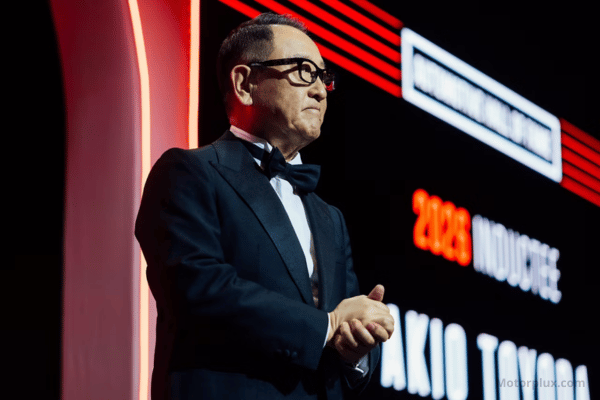
Akio Toyoda, chairman of Toyota Motor Corporation, was inducted into the Automotive Hall of Fame in Detroit on September 23, making him the fourth member of his family to receive the honor. Rather than dwelling on the family legacy, Toyoda used his acceptance speech to deliver a forward-looking message to the more than 700 automakers, dealers, suppliers, and motorsports professionals gathered in the room: the industry’s future depends on collaboration, not competition alone.
A fourth generation, a shared legacy
Toyoda’s induction places him alongside three other members of the Toyoda family already honored by the Hall of Fame: his grandfather Kiichiro Toyoda, inducted in 1994; his father Shoichiro Toyoda, inducted in 2007; and Eiji Toyoda, his grandfather’s cousin, inducted in 2018. Taiichi Ohno, the engineer widely regarded as the father of the Toyota Production System, was inducted in 2022 as well, giving Toyota five honorees connected to its history in an institution that has recognized industry pioneers since 1939 and counts more than 300 names on its roster, including Henry Ford and Ferdinand Porsche.
Greg Penske, vice chairman of Penske Automotive Group, introduced Toyoda by pointing to “the courage to trust his own instincts” — a nod to a leadership style that has often set Toyoda apart from more conventional corporate executives. A tribute video played at the ceremony acknowledged the legacy Toyoda inherited as a member of Toyota’s founding family, while emphasizing that he chose to earn that legacy for himself rather than simply inherit the honor by name alone.
Leadership forged in crisis
Toyoda’s tenure at the top of Toyota has rarely been smooth. He became president in 2009 just as the global financial crisis was unfolding, and shortly afterward faced a wave of vehicle recalls tied to unintended acceleration that forced him to testify before the US Congress — a genuine trial by fire for a new chief executive. Rather than being defined by that crisis, Toyoda used it as a turning point: he overhauled the company’s quality-control systems, decentralized regional decision-making to give individual markets more autonomy, and helped center Toyota’s broader culture around a philosophy of “making ever-better cars.” Under his leadership, which continued as president and at times CEO until 2023 — he remains chairman today — Toyota grew into the world’s largest automaker by production volume.
Toyoda’s personal enthusiasm for cars and motorsports has also become a defining part of his leadership identity within the industry. Known internally and publicly as a passionate “master driver,” he has pushed Toyota to treat racing as a genuine proving ground for both people and vehicles, arguing that lessons learned on a racetrack translate directly into better, more capable production cars.
A message aimed squarely at the room
What made Toyoda’s speech notable wasn’t just the honor itself, but what he chose to say with the platform it gave him. Rather than focusing on his own or his family’s achievements, Toyoda urged the automakers, suppliers, and dealers in attendance to unite their strengths and pursue collective effort rather than treating every competitive challenge as a fight to be won alone. “Like my grandfather and father before me, I am deeply moved by this honor, and I humbly promise to continue to earn it every day in support of this industry and this automotive family that I am so grateful to be a part of,” Toyoda said in his acceptance speech.
That call for cooperation lands at a moment when the global auto industry is navigating an unusually complex set of shared challenges — tariff pressure reshaping manufacturing decisions, the costly transition to software-defined vehicles, and intensifying competition from fast-moving Chinese automakers all pressing on legacy manufacturers at once. Toyoda’s framing suggested he sees those pressures as problems the industry is better positioned to solve together than through purely head-to-head competition between individual companies.
Sharing the stage
Toyoda was one of several honorees recognized at this year’s ceremony. Giampaolo Dallara, the motorsports engineer behind decades of race car chassis design and founder of the renowned constructor that bears his name, joined the 2026 class alongside him, along with the founders of TomTom and Barrett-Jackson. That mix of honorees — spanning corporate leadership, motorsports engineering, navigation technology, and collector-car auctions — reflected the breadth of what the Hall of Fame considers meaningful contribution to the automotive and mobility industry, extending well beyond any single company’s product lineup.
Why it matters
For an industry that spends most of its time locked in direct competition — over market share, over technology, over manufacturing capacity — Toyoda’s induction and the message he chose to deliver with it stand out as a rare, high-profile moment of industry-wide reflection. Whether his call for collaboration translates into any concrete cooperation between rival automakers remains to be seen, but coming from the chairman of the world’s largest automaker, in front of hundreds of the industry’s key decision-makers, it’s a message unlikely to be ignored.