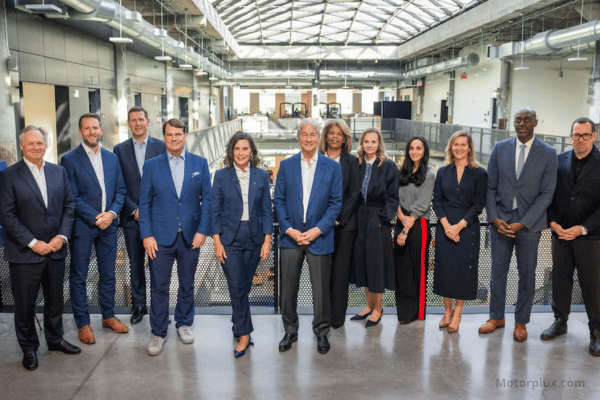
Ford Motor Company, JPMorgan Chase, and the state of Michigan have launched a new public-private initiative aimed squarely at one of the auto industry’s most persistent weaknesses: a domestic supplier base that’s struggled to scale quickly enough to meet manufacturing demand. The program, called Michigan LIFT (Launchpad for Industrial Innovation and Transformation), is targeting $3 billion in combined commitments over the next decade to help suppliers access financing, workforce training, and new customers.
How the money breaks down
Michigan LIFT’s funding structure splits roughly into thirds. Ford has pledged up to $1 billion in direct business contracts awarded to suppliers participating in the platform over the next ten years. JPMorgan Chase has committed up to $1 billion in debt financing to help those same suppliers scale production and meet new demand. The remaining roughly $1 billion is expected to come from additional industrial buyers that Michigan Central, Newlab, and the Michigan Economic Development Corporation aim to bring onto the platform — a goal of attracting 10 to 20 more major buyers representing over $1 billion in annual demand by 2036.
Rather than functioning as a simple grant program, Michigan LIFT is built around what organizers call “Open Calls” — a system that translates specific manufacturing and supply-chain challenges identified by industrial buyers like Ford into public solicitations that innovative suppliers and manufacturers can respond to directly. That structure is meant to connect real, validated demand with the capital and technical capability needed to meet it, rather than funding supplier growth speculatively and hoping demand follows.
Ford as the anchor buyer
Ford is serving as the platform’s anchor industrial buyer, a role that gives the initiative immediate credibility and a concrete source of demand for participating suppliers to build toward. “Ford is America’s automaker, and we believe American manufacturing’s best days are ahead,” said Ford President and CEO Jim Farley in a statement. “Michigan LIFT is about helping solve real manufacturing challenges faster. It connects innovators, suppliers and manufacturers with the support they need to scale.” The program’s priority areas reportedly include scaling robotics and automation and critical minerals processing — two areas where supply bottlenecks have repeatedly slowed vehicle production industry-wide in recent years.
Part of a much larger bank initiative
For JPMorgan Chase, Michigan LIFT isn’t a standalone commitment — it falls under the bank’s broader Security and Resiliency Initiative, a $1.5 trillion, 10-year plan to finance and invest in industries the firm considers critical to national security and economic resilience. Framing a regional manufacturing program as part of a much larger national resilience strategy signals that JPMorgan sees domestic supply chain capacity, including in the auto sector, as a long-term strategic priority rather than a one-off community investment.
Michigan’s governor frames it as a jobs play
Michigan Governor Gretchen Whitmer, whose administration helped bring the initiative together, emphasized the program’s potential to generate high-paying employment alongside its supply-chain goals. “Michigan LIFT will bring together our world-class manufacturers, innovative companies, skilled workers and capital to turn big ideas into real products, new investment and good-paying jobs,” Whitmer said, adding that the partnership is designed to help Michigan businesses grow, strengthen domestic supply chains, and attract new investment to the state. Grant funding tied to the program is expected to go toward teaching manufacturing skills, robotics, and welding, along with broader training program support — addressing workforce readiness alongside the financing and demand-generation pieces of the platform.
Based in a symbolically significant location
Michigan LIFT is headquartered out of Michigan Central and Newlab in Detroit’s Corktown neighborhood — the same campus Ford has spent years redeveloping around the historic Michigan Central Station as a hub for mobility innovation. Housing a new supply-chain initiative there ties Michigan LIFT directly into Ford’s broader, long-running bet on Corktown as a center for next-generation manufacturing and mobility technology, rather than treating it as a separate program housed elsewhere.
Real questions remain about scale
Not everything about Michigan LIFT’s eventual impact is settled. Whether additional major industrial buyers actually join the Open Calls platform at the scale organizers are targeting, and whether smaller, newer suppliers can meet the procurement and quality standards large corporate buyers like Ford require, remain open questions as the initiative moves from launch into actual implementation over the coming years. The program’s ten-year timeline also means its full impact won’t be clear for some time, even as the initial commitments and launch generate immediate attention.
Why it matters
Michigan LIFT arrives at a moment when supply chain resilience has become one of the auto industry’s defining concerns, following years of disruptions ranging from the pandemic-era chip shortage to more recent tariff-driven sourcing shifts. By combining a major automaker’s direct purchasing power, a global bank’s financing capacity, and state-level workforce and economic development resources into a single coordinated platform, Michigan LIFT represents a notably comprehensive attempt to address supplier capacity constraints at their root — rather than simply reacting to the next shortage once it’s already disrupting production lines.