Jaguar Land Rover is moving closer to becoming a US manufacturer for the first time, teaming up with Stellantis to build new, America-specific vehicles under the Defender name. The plan, confirmed by JLR’s own leadership this month, marks a sharp reversal for a company that has spent decades supplying its largest market entirely through imports — and a clear sign of how deeply US tariff policy is reshaping global automakers’ manufacturing decisions.
From “no plans” to a formal manufacturing push
Speaking on the company’s earnings call this month, JLR chief financial officer Richard Molyneux said the automaker’s agreement with Stellantis, first announced as an exploratory memorandum of understanding in May, will now include actual vehicle production at Stellantis facilities in the United States. Molyneux said the move would help JLR get on the “right side” of the tariff barrier and reduce its exposure to currency swings between the pound and the dollar. The two companies expect to formalize a specific manufacturing agreement by the end of this year.
The shift is notable given JLR’s earlier public position. As recently as last year, the company said it had no plans to build vehicles in the US, even as tariff pressure mounted. That stance has clearly changed: the US is Jaguar Land Rover’s single largest global market, accounting for roughly 28 percent of the company’s annual sales, and nearly all of the vehicles it sells there today arrive as imports built at its plants in Solihull, Castle Bromwich and Halewood in the UK.
Why Defender, and why now
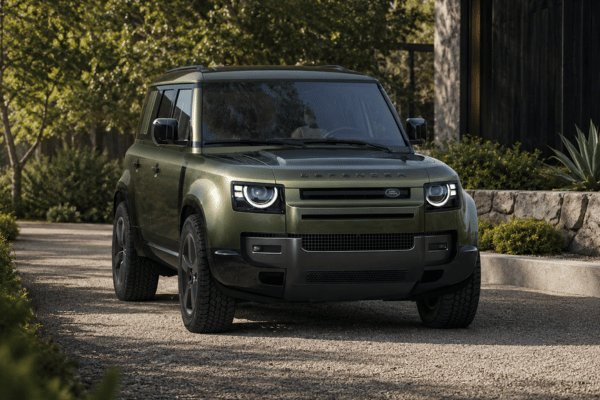
The new US-built vehicles are expected to carry the Defender name specifically, rather than replicate JLR’s existing model lineup. That detail matters: the current Defender is built in Slovakia, which means it faces a 15 percent import duty into the US, compared with a 10 percent rate for JLR’s UK-built models under last year’s UK-US trade agreement. Land Rover’s most rugged and arguably most America-friendly nameplate is, ironically, the one paying the steepest tariff penalty today.
Rather than shipping today’s European-built Defender across the Atlantic, JLR and Stellantis are reportedly working toward new Defender-branded vehicles engineered specifically for the US market. Industry reporting suggests these future models are more likely to sit on a Stellantis truck or SUV platform — potentially related to the architecture underpinning the Jeep Wrangler — rather than JLR’s own EMA platform, which is currently being reserved for higher-end products like the upcoming Range Rover GT, still completing validation testing in the UK ahead of a later 2026 launch.
Borrowing Stellantis’s factory floor
The appeal of partnering with Stellantis instead of building from scratch comes down to time and cost. A new JLR-owned factory in the US would likely take five to seven years to plan, build and staff, at a cost running into the billions of dollars. Stellantis, by contrast, already operates truck and SUV plants across North America — facilities that are built, tooled and staffed today. Using that existing capacity could realistically put a US-assembled Land Rover into American showrooms within two to three years of a confirmed agreement, a dramatically faster path than going it alone.
Part of a broader industry reckoning with tariffs
JLR’s move lands alongside a wider pattern of automakers recalibrating their US strategies around tariff exposure. Stellantis itself has been lobbying the Trump administration to ease tariffs on vehicles built in Canada and Mexico ahead of the 2026 review of the USMCA trade agreement, arguing that current duties on non-US-sourced components add unnecessary cost even for vehicles that otherwise comply with the treaty. Stellantis has also posted a multibillion-dollar first-half loss tied in part to tariff impacts, and has said it expects more of that pressure to show up in its results as 2026 continues.
For JLR, a British luxury manufacturer with no US factory footprint of its own, the Stellantis partnership offers something the company can’t easily build alone: fast, tariff-shielded access to its most important market. It is still an early-stage agreement — a non-binding MOU rather than a signed manufacturing deal — but the direction is now unmistakable. After decades of exporting into the US from the UK, Jaguar Land Rover appears headed toward becoming, at least partially, an American manufacturer.