Electric vehicle manufacturer Rivian has reported delivery figures that came in ahead of market expectations, offering a positive signal for a company that has faced the same steep challenges that define early-stage EV production. The results suggest that Rivian’s ongoing efforts to stabilize and expand its manufacturing operations are beginning to yield measurable results.
For an automaker still working to establish its footing in a highly competitive segment, surpassing delivery targets — even modestly — carries meaningful weight. It indicates that demand for Rivian’s lineup, anchored by the R1T pickup and R1S SUV, remains resilient, and that the company is gradually closing the gap between ambition and execution.
Production Ramp Remains the Central Challenge
Scaling production has been one of the defining hurdles for Rivian since it began delivering vehicles. Like many EV startups before it, the company encountered the hard reality that assembling complex electric vehicles at volume is an entirely different proposition than engineering them.
Supply chain constraints, component shortages, and the inherent complexity of building a new automotive manufacturing operation from the ground up have all contributed to production challenges in previous periods. The latest delivery numbers suggest those pressures, while not entirely resolved, are being managed with greater effectiveness.
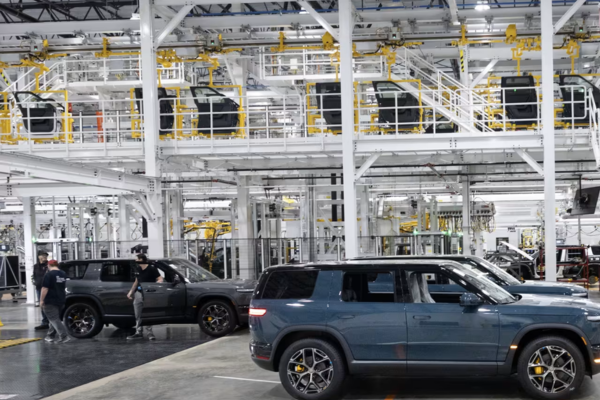
Rivian’s Normal, Illinois facility — its primary production plant — has been at the center of these scaling efforts. Improvements to production line efficiency and parts procurement appear to be contributing to a steadier output cadence, which is directly reflected in the improved delivery performance.
What Stronger Deliveries Mean for Rivian’s Position
In the broader EV landscape, delivery figures serve as one of the clearest indicators of a company’s operational health. For investors, analysts, and industry observers, beating expectations — even when those expectations are measured — signals that a company is moving in the right direction.
For Rivian specifically, this matters beyond just the numbers. The company operates in a segment where it faces competition from established automakers with far greater resources, as well as from Tesla’s growing lineup of trucks and SUVs. Demonstrating consistent delivery growth strengthens Rivian’s credibility as a long-term player in the market.
Additionally, Rivian’s commercial vehicle business — supplying electric delivery vans to Amazon — provides a secondary production and revenue stream that complements its consumer vehicle segment. Progress on both fronts reinforces the company’s broader operational narrative.
Looking Ahead: The Road to Sustainable Scale
While the stronger-than-expected delivery report is an encouraging development, industry analysts are quick to note that Rivian still faces a demanding path ahead. Profitability remains a longer-term objective, and achieving it will require the company to continue increasing production volume while simultaneously managing costs with greater discipline.
The upcoming introduction of the more affordable R2 platform is widely viewed as a pivotal moment for Rivian’s growth trajectory. By targeting a broader consumer base with a lower price point, the company aims to expand its addressable market significantly — a move that could dramatically change its production and delivery scale over time.
For now, however, the current results offer a moment of measured optimism. Rivian appears to be building the operational foundation necessary to support sustained growth, one delivery at a time.
A Positive Milestone in an Ongoing Journey
Stronger-than-expected deliveries do not resolve every challenge Rivian faces, but they represent tangible evidence that the company’s production ramp is progressing. In an industry where execution is everything, the ability to meet and exceed targets — even incrementally — is a meaningful step forward.
As the EV market continues to evolve and competition intensifies, Rivian’s capacity to deliver on its promises, quite literally, will remain one of the most closely watched metrics in the industry.