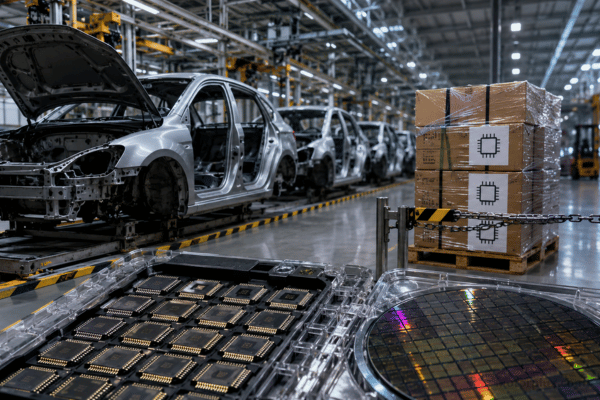
When the global semiconductor shortage first sent shockwaves through the automotive industry in the early 2020s, many analysts predicted a relatively swift recovery. Component inventories would stabilize, production would normalize, and automakers would return to full capacity within a year or two. That forecast turned out to be far more optimistic than reality warranted. As 2025 unfolds, the chip shortage continues to disrupt vehicle manufacturing, delay deliveries, and reshape long-term business strategies across the global auto sector.
Why Semiconductors Matter So Much to Modern Vehicles
Today’s vehicles are, in many ways, computers on wheels. A modern automobile can contain hundreds of electronic control units — microprocessors that govern everything from engine performance and transmission behavior to infotainment systems, advanced driver assistance features, and battery management in electric vehicles. As cars have grown more technologically sophisticated, their dependency on semiconductors has grown in parallel.
This dependency created a structural vulnerability that the industry was slow to recognize. For decades, automakers relied on lean, just-in-time supply chain models that minimized inventory costs. When demand for chips surged simultaneously across the automotive sector, consumer electronics, and the broader technology industry, manufacturers found themselves at the back of a very long queue.
The Factors Keeping the Shortage Alive in 2025
The persistence of the chip shortage into 2025 is the result of several overlapping pressures rather than a single cause.
- Geopolitical tensions continue to affect the supply of chips manufactured in key regions, creating uncertainty around long-term sourcing strategies.
- Rising complexity of automotive chips — particularly those needed for electric vehicle battery management and advanced driver assistance systems — requires specialized fabrication processes that are not easily scaled.
- New investment cycles move slowly. Building semiconductor fabrication plants is a multi-year, capital-intensive undertaking. Plants announced in response to the crisis are only now beginning to come online, and full capacity takes time to develop.
- Demand continues to accelerate. The global push toward electrification has increased the semiconductor content per vehicle significantly, meaning that even as supply expands, demand often expands faster.
Impact on Vehicle Production and Consumers
For automakers, the ongoing disruption translates into difficult production decisions. Some manufacturers have chosen to release vehicles with temporarily reduced feature sets, omitting certain electronic functions with the intention of retrofitting them later. Others have been forced to idle assembly lines when critical components are unavailable, leading to lost production capacity and revenue.
For consumers, the effects are visible at the dealership level. Inventory remains tighter than historical norms in several segments, contributing to pricing pressure and extended wait times for certain models — particularly those with advanced technology packages or full-electric powertrains.
How the Industry Is Adapting
Automakers and suppliers are not standing still. The crisis has prompted a fundamental rethinking of supply chain architecture that is already producing structural changes.
Many manufacturers have moved toward direct relationships with chip producers, bypassing traditional Tier 1 and Tier 2 supplier layers to gain greater visibility and priority in allocation. Others are investing in proprietary chip design capabilities, following a trend established by technology companies that developed in-house silicon to reduce dependence on external suppliers.
Regional diversification of chip sourcing is also accelerating. Governments in North America, Europe, and Asia have launched initiatives to incentivize domestic semiconductor manufacturing, recognizing that concentrated supply chains carry systemic risks that extend well beyond the auto sector.
Looking Ahead
The global chip shortage has fundamentally altered how the automotive industry thinks about supply chain resilience. The assumption that critical components would always be available on demand has been replaced by a more cautious, strategically diversified approach. While conditions are gradually improving, the imbalance between supply and the growing technological appetite of modern vehicles is unlikely to fully resolve in the near term.
For an industry already navigating the complex transition to electrification and software-defined mobility, managing semiconductor supply will remain one of its most consequential operational challenges well into the latter half of the decade.