General Motors has quietly reached a genuine milestone in battery sustainability: new Cadillac, Chevrolet, and GMC electric vehicles are now leaving the factory with battery cells built from cathode material that is 100 percent recycled nickel, cobalt, and manganese — and these aren’t internal test vehicles, they’re regular production EVs headed straight to customers.
From old battery to new cell, start to finish
The pilot program, completed this month in partnership with battery recycling company Cirba Solutions, traces a genuinely closed loop. End-of-life battery packs from GM EVs — spanning Cadillac, Chevrolet, and GMC models — were sent to a Cirba Solutions facility in Ohio, where workers disassembled and shredded them into what the industry calls “black mass,” a concentrated intermediate material containing the valuable critical minerals locked inside a used battery. From there, GM’s teams refined that black mass into more than 12 metric tons of new cathode active material, with the nickel, cobalt, and manganese content coming entirely from recycled sources rather than freshly mined ore.
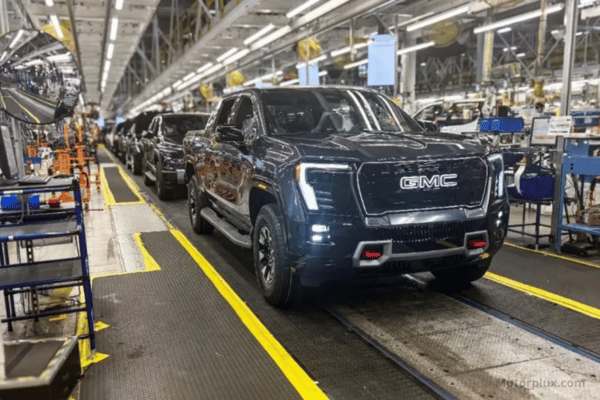
That recycled cathode material then went to Ultium Cells, the battery joint venture between GM and LG Energy Solution, where it was manufactured into brand-new battery cells. GM’s own manufacturing teams assembled those cells into battery modules and packs at the company’s Factory ZERO and Spring Hill assembly plants, before installing them into vehicles — including early GMC Sierra EV units — that have already left the factory for customers.
Meeting the same bar as newly mined materials
The central technical challenge in any battery recycling effort is proving that recovered materials can actually perform as well as virgin ones, since a battery with compromised cathode material isn’t a reasonable trade-off for sustainability — it would risk both safety and the real-world range and durability customers expect. GM says the recycled cathode material was validated against the same quality, safety, and performance standards required for any new EV battery material, and that cells built with the recycled content performed comparably to cells made entirely from newly mined minerals in testing. “This new cathode active material was validated to the same high quality, safety and performance standards required for use in an electric vehicle, and cells made with recycled materials performed as well as those made from virgin material,” said Kurt Kelty, GM’s vice president of battery and sustainability.
That validation step matters enormously for how seriously the rest of the industry is likely to take this pilot. A recycling announcement that cuts corners on performance wouldn’t just risk individual vehicles — it would undermine confidence in battery recycling as a viable strategy at all. By clearing the same bar required of virgin materials, GM’s pilot offers real evidence that recycled content doesn’t have to mean a compromised product.
Why critical minerals are the real prize here
Nickel, cobalt, and manganese are among the most expensive and geopolitically sensitive inputs in modern EV battery production, with global supply chains for these minerals concentrated in a relatively small number of countries and subject to price volatility, mining capacity constraints, and in some cases, significant environmental and labor concerns at the extraction stage. A functioning domestic recycling pathway reduces an automaker’s exposure to all of those pressures simultaneously — it’s a source of critical minerals that doesn’t require new mining, doesn’t depend on potentially unstable international supply chains, and scales up naturally as more EVs reach the end of their service lives in the years ahead.
Recycling is just the last stop, not the first
GM has been explicit that this closed-loop recycling pilot represents one stage in a much longer plan for what happens to an EV battery once a vehicle reaches the end of its life, rather than the only strategy the company is pursuing. Some retired battery packs may be refurbished and returned to service in other vehicles; others are being redirected toward stationary energy storage applications — GM is working with battery recycling company Redwood Materials to deploy roughly 10,000 used EV batteries into stationary storage systems specifically. Only once a pack has exhausted those other potential uses does it move toward full material recycling, extracting the valuable minerals inside for use in an entirely new battery.
What it means for the industry and for shoppers
For GM, this pilot provides a real, validated foundation for expanding battery circularity as its own EV fleet ages and more vehicles reach end-of-life in the coming years — a supply of critical minerals that grows in parallel with the EV market itself rather than depending entirely on new mining to keep pace with demand. The company has also framed the effort as part of a broader goal of reducing both the carbon footprint of its battery materials and the eventual cost to consumers, since recycled minerals can offer a more stable, less volatile input cost than newly mined materials subject to global commodity price swings.
For EV shoppers, the practical takeaway is reassuring rather than dramatic: a battery built partly from recycled materials performs identically to one built entirely from newly mined minerals, based on GM’s own testing. As more automakers look for ways to reduce both environmental impact and raw material costs, GM’s successful validation of recycled cathode material at production scale offers a concrete, working example — the kind of genuine before-and-after story the EV industry’s sustainability promises don’t always deliver.