For decades, infotainment and safety systems lived in separate corners of the vehicle architecture. Navigation screens, audio controls, and connectivity features occupied one domain, while collision warnings, lane monitoring, and driver assistance functions operated largely in the background. Today, that division is rapidly disappearing. Digital cockpit platforms are bringing these two worlds together, creating a unified interface that manages entertainment, connectivity, and critical safety functions through a single, intelligent layer of technology.
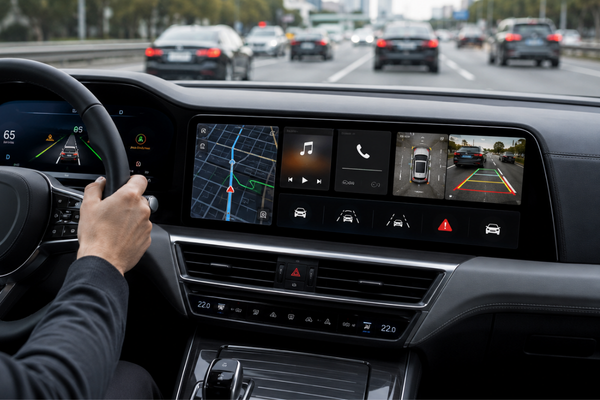
This convergence is not simply a design trend. It reflects a deeper shift in how automakers and technology suppliers think about the role of software inside a vehicle — and how much of the driving experience can, or should, be managed through a centralized digital environment.
What a Digital Cockpit Platform Actually Does
A digital cockpit platform is essentially the software and hardware framework that controls everything a driver and passengers interact with through screens, displays, and voice interfaces inside a vehicle. This includes the instrument cluster, the central touchscreen, head-up display content, and increasingly, the alerts and visual cues generated by advanced driver assistance systems.
As these platforms have grown more sophisticated, automakers have found it both practical and strategic to route safety-relevant information through the same visual and audio channels used for infotainment. A lane departure warning, for example, may now appear as a graphic overlay on a head-up display that also shows navigation directions. A forward collision alert might interrupt audio playback with a specific tone and a visual signal on the main touchscreen.
The result is a more coherent experience for the driver — but one that requires careful engineering to ensure that safety-critical alerts are never obscured, delayed, or deprioritized by entertainment content.
The Engineering Challenge Behind Integration
Merging infotainment with safety functions is technically demanding. Safety systems require deterministic, real-time performance — meaning they must respond within strict time constraints regardless of what else the system is doing. Infotainment software, by contrast, often runs on more flexible, consumer-oriented operating systems that may not meet the same reliability standards.
To address this, leading suppliers and automakers have adopted approaches such as hardware virtualization, which allows safety-critical and non-critical software to run simultaneously on shared processors without one interfering with the other. Functional safety standards provide frameworks that define how systems must behave to protect occupants, even when other software components experience a fault.
This technical discipline is what separates a genuinely integrated digital cockpit from a system that simply places safety alerts on an entertainment screen without the underlying guarantees that drivers depend on.
Driver Attention as a Common Thread
One of the most significant areas where infotainment and safety now overlap is driver monitoring. Modern cockpit platforms increasingly incorporate driver attention systems that use in-cabin cameras to assess whether the person behind the wheel is focused on the road. When distraction or fatigue is detected, the platform can reduce screen brightness, suppress non-essential notifications, or trigger an alert — all managed through the same interface that otherwise handles music, calls, and navigation.
This kind of contextual awareness marks a meaningful step forward. Rather than treating infotainment and safety as parallel but separate streams, the vehicle begins to use one to inform the other in real time.
Looking Ahead
As software-defined vehicles become more common and over-the-air updates allow cockpit platforms to evolve after purchase, the boundary between infotainment and safety will likely continue to blur. Automakers that invest in robust, scalable digital cockpit architectures today are positioning themselves to deliver vehicles that grow more capable — and potentially safer — over time.
For drivers, the practical impact is a cabin that feels more intuitive and responsive. The challenge for the industry is ensuring that as digital cockpits become more powerful, the integrity of safety functions is never treated as secondary to the quality of the entertainment experience.