The automotive industry has always been defined by its ability to adapt to transformative technologies. From assembly line automation to computer-aided design, each wave of innovation has reshaped how vehicles are conceived and built. Today, generative artificial intelligence is emerging as one of the most significant forces yet to influence how automakers design, engineer, and validate the cars of tomorrow.
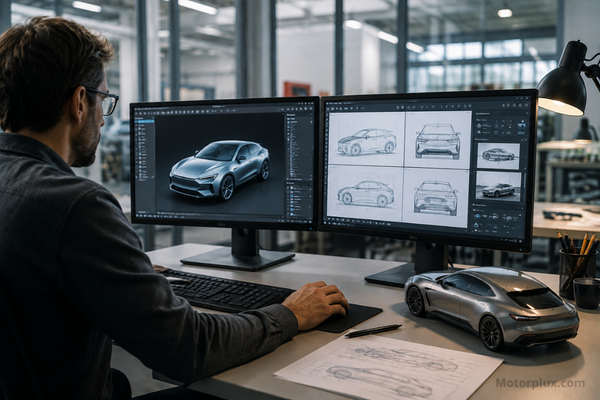
Unlike conventional software tools that assist human designers in executing predefined concepts, generative AI operates differently. It can autonomously generate thousands of design iterations, simulate structural behaviors, and flag performance issues — all within timeframes that would be impossible through traditional workflows. The result is a fundamental shift in how engineering and creative teams collaborate and make decisions.
Reimagining the Design Studio
In the traditional automotive design process, translating a creative vision into a manufacturable vehicle often takes years. Designers sketch concepts, clay models are sculpted, and iterative feedback loops consume significant time and resources. Generative AI is compressing this cycle dramatically.
By feeding design parameters — such as aerodynamic targets, material constraints, weight limits, and aesthetic guidelines — into AI-driven platforms, design teams can receive hundreds of viable structural and visual alternatives in a matter of hours. These outputs are not random; they are optimized proposals that balance engineering requirements with design intent.
This capability is particularly valuable in areas such as lightweighting, where AI can generate complex lattice structures and organic geometries that reduce component weight while maintaining or improving strength — solutions that human designers would rarely arrive at intuitively.
Accelerating Safety Validation and Testing
Beyond the design studio, generative AI is having an equally profound impact on the testing and validation phase of vehicle development. Crash simulations, thermal analysis, fluid dynamics modeling, and durability testing have historically required enormous computational resources and extended timelines.
AI-powered simulation tools can now generate predictive models that anticipate how a vehicle will perform under a wide range of conditions before a single physical prototype is built. This ability to virtually stress-test components and assemblies early in the development cycle allows engineering teams to identify weaknesses, refine solutions, and reduce costly late-stage design changes.
The implications for safety are significant. By broadening the scope and speed of virtual testing, manufacturers can explore a greater number of failure scenarios, improving the robustness of safety systems and reducing reliance on expensive physical crash test programs.
Bridging the Gap Between Innovation and Production
One of the most compelling aspects of generative AI in automotive development is its ability to align creativity with manufacturability from the earliest stages of a project. Historically, there has often been tension between what designers envision and what production processes can realistically deliver.
Modern generative AI platforms can be trained on manufacturing constraints, supply chain parameters, and material availability, ensuring that the design solutions they propose are not only innovative but also viable for large-scale production. This bridges a gap that has long slowed the journey from concept to showroom.
The Human Element Remains Central
Despite the impressive capabilities of generative AI, industry professionals consistently emphasize that human judgment remains irreplaceable. AI tools generate options; experienced designers and engineers evaluate, refine, and make the critical decisions that define a vehicle’s character, safety profile, and market positioning.
The technology is best understood as a powerful amplifier of human expertise rather than a replacement for it. Teams that integrate AI into their workflows thoughtfully are finding that they can focus more of their energy on high-value creative and strategic decisions, while routine iteration and analysis are handled at machine speed.
Looking Ahead
As generative AI tools continue to mature and become more deeply embedded in automotive development pipelines, their influence on product timelines, development costs, and vehicle innovation is expected to grow substantially. Automakers that invest in building internal competencies around these technologies today are likely to hold meaningful competitive advantages as the broader industry accelerates its digital transformation.
For an industry where innovation cycles are long and the stakes are high, generative AI represents not just a new tool — but a genuine rethinking of how great vehicles are made.