For decades, vehicle maintenance followed a simple and largely reactive logic: something breaks, you fix it. Scheduled service intervals offered a modest improvement, but they were never fully tailored to the actual condition of a vehicle. Today, predictive maintenance technology is fundamentally changing that equation — and the results are being felt across private ownership, commercial fleets, and the broader automotive industry.
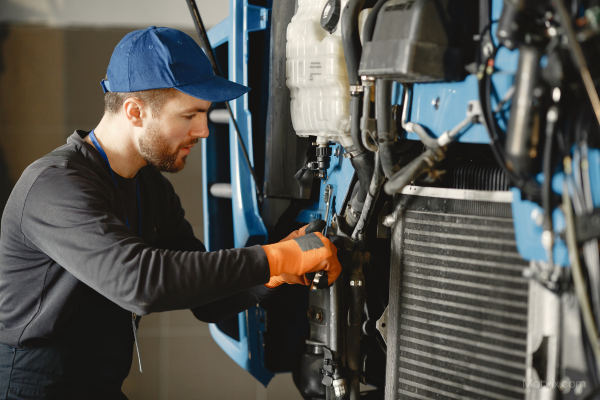
Rather than waiting for a warning light to appear on the dashboard or for a component to fail without notice, predictive maintenance systems continuously monitor vehicle health in real time. By analyzing data from dozens of onboard sensors, these platforms can detect subtle signs of wear, stress, or deterioration long before they escalate into a breakdown.
The Technology Behind the Prediction
At the core of modern predictive maintenance are three interconnected technologies: advanced sensor networks, artificial intelligence, and cloud connectivity.
- Onboard sensors track critical variables such as engine temperature, brake pad thickness, battery voltage, transmission fluid condition, and tire pressure — often in real time.
- AI and machine learning algorithms process this continuous stream of data, comparing it against historical patterns and known failure signatures to identify anomalies before they become serious.
- Cloud platforms aggregate data across entire vehicle fleets, allowing operators and manufacturers to identify systemic issues and push remote diagnostics or software updates when needed.
Together, these elements create a system that does not simply report a problem — it anticipates one. The difference between receiving an alert days before a brake failure and discovering it on the highway represents a significant leap in both safety and cost efficiency.
Impact on Fleet Operations and Commercial Transport
The commercial sector has emerged as one of the most enthusiastic adopters of predictive maintenance technology. For businesses that depend on fleets of trucks, vans, or delivery vehicles, an unplanned breakdown does not just mean a repair bill — it means delays, missed commitments, and reputational damage.
Fleet managers using predictive platforms report a measurable reduction in unplanned downtime. Maintenance can be scheduled during low-demand periods, spare parts can be ordered in advance, and technicians can be prepared before a vehicle even arrives at the service bay. This level of operational precision was simply not possible under traditional maintenance models.
Benefits for Everyday Drivers
Predictive maintenance is not exclusively a commercial tool. An increasing number of consumer vehicles now come equipped with connected features that bring similar capabilities to everyday drivers. Automakers are integrating these systems into their infotainment and companion apps, offering vehicle health summaries, service reminders triggered by actual component condition rather than mileage alone, and direct communication channels with authorized dealerships.
For drivers, the practical benefits are clear:
- Reduced risk of unexpected and potentially dangerous roadside failures.
- Lower long-term maintenance costs through early intervention.
- Greater peace of mind, particularly for those who drive high mileage or rely on their vehicle for critical daily needs.
Challenges and Considerations
Despite its clear advantages, predictive maintenance technology is not without limitations. Data privacy remains a relevant concern, as continuous vehicle monitoring generates substantial amounts of information about driver behavior and usage patterns. Transparency around how this data is stored, shared, and used will be essential to building lasting consumer trust.
Additionally, the effectiveness of these systems depends heavily on the quality and accuracy of the underlying algorithms. A false positive — alerting a driver to a non-existent problem — can erode confidence in the technology just as quickly as a missed diagnosis.
Looking Ahead
As vehicles become increasingly software-defined and connected, predictive maintenance will only grow more sophisticated. Integration with electric vehicle battery management systems, autonomous driving components, and even infrastructure data opens new possibilities for anticipating failures at a level of precision previously unimaginable.
What is already clear is that the industry’s approach to vehicle upkeep is undergoing a fundamental transformation. The question is no longer whether predictive maintenance will become standard — it is how quickly drivers and operators will fully embrace the shift from reacting to problems to preventing them altogether.