Inside every modern electric vehicle, a quiet revolution is taking place — not in the battery pack, not in the software interface, and not in the aerodynamic body panels. It is happening at the chip level, where a material called silicon carbide is fundamentally changing the way power flows through an EV’s electronics.
Beyond Silicon: Why the Material Matters
For decades, conventional silicon has served as the backbone of power electronics across virtually every industry. It is abundant, well-understood, and relatively inexpensive to manufacture. But silicon has physical limitations that become increasingly problematic as engineers push electric vehicles toward higher voltages, faster charging speeds, and greater energy efficiency.
Silicon carbide — often abbreviated as SiC — overcomes many of these constraints. As a wide-bandgap semiconductor, it can operate at higher temperatures, handle higher voltages, and switch electrical current far more rapidly than traditional silicon. These characteristics translate directly into meaningful performance improvements in electric drivetrains.
The Role of SiC in an EV Powertrain
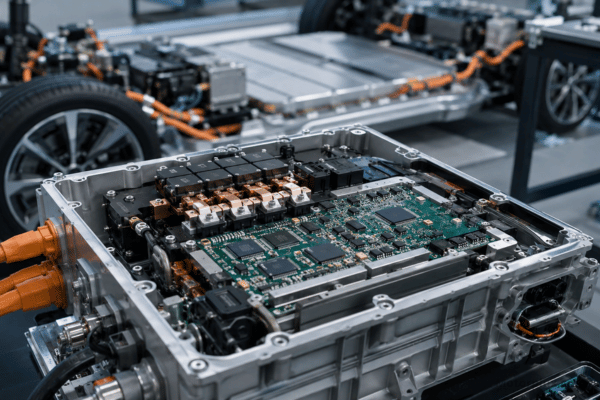
In an electric vehicle, power electronics serve as the critical intermediary between the battery and the electric motor. The inverter, which converts direct current from the battery into the alternating current that drives the motor, is one of the most energy-sensitive components in the entire system.
When silicon carbide chips are used in these inverters, the conversion process becomes significantly more efficient. Less energy is lost as heat during each switching cycle, meaning more of what is stored in the battery actually reaches the wheels. Over a full driving cycle, this improvement in efficiency can contribute to a meaningful increase in range — a factor that remains one of the most critical purchase considerations for prospective EV buyers.
Beyond range, SiC-based inverters support higher operating voltages, enabling faster DC charging without placing excessive thermal stress on the system. As automakers move toward 800-volt architectures to support ultra-fast charging, silicon carbide has become less of an option and more of a necessity.
From Niche Application to Industry Standard
Silicon carbide is not a new discovery. The material has been used in industrial and aerospace applications for years, valued precisely for its thermal and electrical properties. What has changed is the automotive industry’s readiness — and urgency — to adopt it at scale.
Major automakers have progressively integrated SiC power modules into their premium and performance electric models, with the technology now filtering down into more mainstream segments. Simultaneously, leading semiconductor manufacturers have invested heavily in expanding SiC wafer production capacity, recognizing that automotive demand is becoming one of the most significant growth drivers in the sector.
This shift has not been without challenge. Silicon carbide wafers are more difficult and expensive to produce than standard silicon wafers. Defect rates, substrate availability, and manufacturing yield have all presented obstacles that the industry continues to address through sustained investment and process refinement.
Efficiency That Consumers Feel, Even If They Cannot See It
For most drivers, silicon carbide will never be a visible feature. It will not appear prominently in marketing brochures or showroom conversations. Yet its influence is increasingly present in the numbers that do matter to consumers: kilowatt-hours per hundred kilometers, minutes to reach an 80 percent charge, and the thermal stability that preserves battery longevity over time.
In this sense, SiC exemplifies a broader pattern in automotive technology development — foundational advances that happen beneath the surface, enabling the headline achievements that automakers ultimately bring to market.
Looking Ahead
As electric vehicle adoption accelerates and competition among manufacturers intensifies, the pressure to extract maximum performance from every component will only grow. Silicon carbide sits at the intersection of that pressure and the physical limits of what conventional materials can deliver.
The engineers who design tomorrow’s electric vehicles are already working with SiC not as a premium differentiator, but as a standard tool. That transition — from emerging technology to assumed baseline — is perhaps the clearest measure of how profoundly this quiet semiconductor has already changed the landscape of EV power electronics.