Blind spots have long been one of the most persistent and dangerous challenges in everyday driving. Despite decades of improvements in mirror design, camera systems, and proximity sensors, accidents caused by undetected vehicles in adjacent lanes continue to occur with troubling regularity. Now, a maturing technology known as Vehicle-to-Vehicle communication — commonly referred to as V2V — is positioning itself as a potential solution that goes far beyond what any mirror or sensor can offer.
Unlike passive safety systems that rely on a single vehicle’s onboard cameras or radar, V2V communication creates a dynamic network between multiple vehicles on the road simultaneously. Each car broadcasts its position, speed, and direction to nearby vehicles in real time, giving drivers — and increasingly, the vehicle itself — a far more complete picture of the surrounding environment.
How V2V Communication Works
At its core, V2V technology uses a dedicated short-range wireless communication protocol to transmit and receive data packets between vehicles dozens of times per second. This means that even when a motorcycle or compact car sits entirely outside a driver’s visual field — tucked into a blind zone between mirrors — the host vehicle can still receive a signal alerting it to that vehicle’s presence, trajectory, and relative speed.
The practical implication is significant. A driver preparing to change lanes on a busy highway could receive an audible or visual warning not because a sensor detected a reflection or proximity, but because the neighboring vehicle actively announced itself. This is a fundamentally different approach to collision avoidance — one based on shared situational awareness rather than reactive detection.
Blind Spots: A Persistent Danger
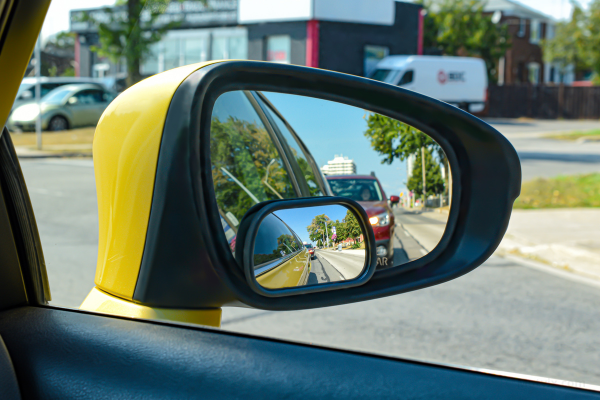
Blind spot-related collisions are disproportionately common during lane changes and merging maneuvers, particularly in high-traffic environments. Larger vehicles such as trucks and SUVs face an amplified version of this challenge, with blind zones that can conceal entire vehicles from the driver’s line of sight. Traditional blind spot monitoring systems, while helpful, depend on line-of-sight sensors and can be limited by adverse weather, road geometry, or sensor range.
V2V addresses several of these limitations at once. Because it operates through radio frequency communication rather than optical or ultrasonic sensing, it is inherently less affected by rain, fog, or sharp curves in the road. A vehicle transmitting its position around a bend can alert an approaching car well before any camera or radar system would register its presence.
Integration with Broader Safety Ecosystems
V2V does not exist in isolation. It is increasingly discussed as a component of a broader connected mobility framework that includes Vehicle-to-Infrastructure (V2I) communication — where vehicles interact with traffic signals, road sensors, and highway management systems. Together, these technologies form what many in the automotive industry describe as the foundation for cooperative intelligent transportation systems.
When combined with advanced driver assistance systems (ADAS) already present in modern vehicles, V2V has the potential to trigger automatic corrective responses, not just warnings. A vehicle that receives a V2V signal from a fast-approaching car in its blind spot could apply gentle steering resistance or delay a lane change until the path is clear — all without direct driver input.
Challenges Still Ahead
Despite its promise, widespread V2V adoption faces real-world obstacles. For the technology to reach its full potential, a critical mass of vehicles equipped with compatible hardware must be present on the roads simultaneously. A single V2V-enabled car operating among vehicles with no such capability gains only a fraction of the intended benefit.
Standardization across manufacturers and regulatory frameworks also remains a work in progress in many markets. Questions around data privacy, cybersecurity, and spectrum allocation require coordinated responses from industry stakeholders and government agencies alike.
The Road Toward Safer Lane Changes
V2V communication represents one of the most compelling arguments for a connected automotive future. By transforming each vehicle from a passive road user into an active participant in a shared safety network, the technology targets one of driving’s oldest blind spots — quite literally. As more manufacturers integrate compatible hardware and regulatory clarity improves, the prospect of dramatically reducing blind spot accidents moves closer from concept to everyday reality.
The question is no longer whether V2V can make roads safer. The question is how quickly the infrastructure, regulation, and market adoption can align to let it do so.