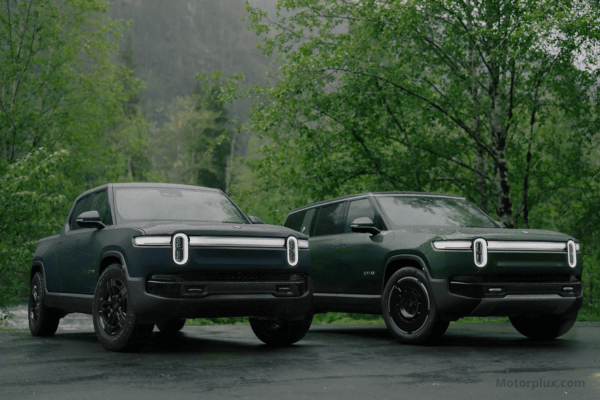
Rivian just gave its entire customer base one of the more meaningful gifts an automaker can offer: a free software update that makes every vehicle on the road noticeably better, regardless of when it was bought. With RivianOS 2, the company has unified its full lineup — first-generation R1 trucks and SUVs, second-generation R1 models, and the newer R2 — onto a single software platform for the first time, closing a gap that had left older vehicles increasingly disconnected from Rivian’s newest features.
Ending years of software fragmentation
Until this update, Rivian’s vehicle software had effectively drifted apart over time. First-generation R1 trucks and SUVs, second-generation R1 models, and the new R2 had each accumulated their own software quirks and feature sets as the company iterated quickly across several hardware generations. That’s a common growing pain for any fast-moving tech company, but it’s a particularly awkward one for a car brand, where owners reasonably expect their vehicle to keep improving over time rather than falling further behind newer models with each passing year.
RivianOS 2, delivered as the 2026.31 over-the-air update, addresses that head-on by placing every R1 and R2 vehicle on one unified software stack. The result, according to Rivian, is the single biggest software transformation in the R1’s history — a rebuilt cabin interface, expanded AI capabilities, and real-time navigation data extended to the entire range at once, rather than being reserved for the newest hardware.
What actually changes inside the car
The update brings a redesigned interface with dynamic controls, a repositionable media player, and a new context-aware settings system with universal search built in — practical, everyday improvements that make the vehicle noticeably easier to live with. Connect+ subscribers also gain a dedicated weather application with air quality data and 10-day forecasts, along with a live trips feature that lets drivers manage active routes directly from the Rivian mobile app.
Rivian is also giving owners considerably more control over their own data as part of the update. Across every vehicle generation, drivers can now toggle wake-word detection on or off, restrict location sharing, and adjust driver-profile data — privacy controls that put meaningful choice in owners’ hands rather than defaulting everything to “on.”
Smart about hardware limits, not just software ambition
What makes RivianOS 2 particularly well thought-out is how it handles the real differences in computing power across Rivian’s vehicle generations. Rather than forcing every vehicle to run identical, compute-intensive graphics regardless of what its hardware can actually support, Rivian tailored the experience: R2 and Gen 2 R1 models get Unreal Engine 5 for real-time 3D visualizations of the vehicle and its surroundings, while Gen 1 R1s remain on the lighter Unreal Engine 4 to keep their screens responsive on older hardware. Both generations, meanwhile, gain expanded cloud-assisted voice capabilities and refreshed driver display layouts, so even the oldest vehicles in Rivian’s fleet get meaningful upgrades rather than being left out of the update entirely.
Underpinning all of it is Rivian Unified Intelligence, a shared AI foundation connecting vehicle, mobile, and service functions across the lineup. On R2 and Gen 2 R1 models, that includes hybrid edge computing for low-latency, on-vehicle AI processing; Gen 1 R1 owners get expanded cloud-assisted voice features that bring much of the same intelligence to older hardware, just processed differently under the hood.
A single platform means faster improvements for everyone
Beyond the specific features in this release, the more important shift is structural: by consolidating R1 and R2 onto one shared software stack, Rivian no longer has to maintain and update multiple, diverging codebases in parallel. That should translate directly into faster future updates across the entire lineup, since new features developed for one part of the fleet can now roll out to the rest far more efficiently than when the platforms were fragmented. For owners, that’s the difference between a car that occasionally gets a feature update and one that’s genuinely designed to keep improving throughout its ownership life.
Why it’s good news for EV buyers generally
Rivian’s willingness to bring its newest software experience to years-old vehicles — rather than reserving the best updates for the newest hardware only — sets a meaningful bar for the rest of the EV industry. As more automakers lean into over-the-air updates as a selling point, how a company treats its existing customers when new software ships is a real test of whether that promise is genuine. With RivianOS 2, Rivian gave every owner, old and new, a materially better vehicle without asking them to pay anything or trade in for a newer model — exactly the kind of outcome the software-defined vehicle era was supposed to deliver in the first place.