For years, the automotive industry has spoken of fully autonomous vehicles as an inevitable destination. Yet the journey has proven far more complex than early predictions suggested. Today, a new wave of converging technologies is quietly but meaningfully closing the gap between the driver-assistance systems already on the road and the fully self-driving vehicles still on the horizon.
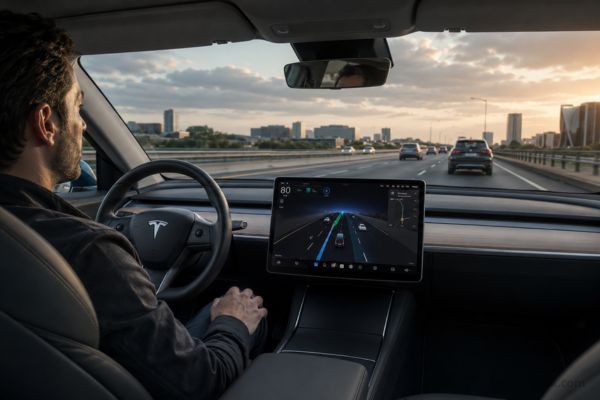
Understanding where that gap exists — and what is being done to bridge it — requires looking at the specific technological layers that separate a car that warns you from one that drives itself.
Sensor Fusion: Seeing the Full Picture
One of the most critical advances reshaping autonomous capability is sensor fusion — the integration of data from multiple perception systems, including cameras, radar, LiDAR, and ultrasonic sensors, into a single coherent environmental model.
Earlier driver-assistance systems often relied on one dominant sensing technology, which created significant blind spots in adverse conditions. Modern systems are designed to cross-validate inputs from multiple sources simultaneously, allowing the vehicle to maintain a reliable understanding of its surroundings even when individual sensors are compromised by weather, glare, or obstruction.
This redundancy is not merely a safety feature — it is a foundational requirement for any system aspiring to operate without human oversight.
AI at the Edge: Processing Power That Rides Along
Greater sensor capability produces greater volumes of data. The challenge becomes processing that data fast enough to make real-time driving decisions. This is where edge computing and dedicated AI processing chips have become indispensable.
Purpose-built automotive-grade processors now allow vehicles to analyze complex scenarios — pedestrian behavior, intersection dynamics, lane merges — within milliseconds, without relying on cloud connectivity. This on-board intelligence is essential for situations where a network connection is unavailable or simply too slow to be useful.
The sophistication of these neural networks has grown considerably, enabling systems to predict the likely behavior of other road users rather than simply reacting to what has already happened.
Vehicle-to-Everything Communication
No vehicle, however sophisticated its internal sensors, can see around corners or anticipate signal changes. Vehicle-to-everything (V2X) communication addresses this limitation by enabling cars to exchange data with infrastructure, other vehicles, and network management systems in real time.
When a traffic light broadcasts its timing cycle directly to approaching vehicles, or when a car ahead transmits an emergency braking signal before its brake lights even activate, the autonomous system gains a perceptual advantage that no onboard sensor alone can replicate. V2X effectively extends the vehicle’s awareness beyond its physical line of sight — a capability that is central to safe autonomous operation in dense, unpredictable environments.
High-Definition Mapping and Localization
Knowing what surrounds a vehicle in real time is one challenge. Knowing precisely where that vehicle sits within a mapped environment is another. High-definition mapping combined with centimeter-level localization allows autonomous systems to cross-reference live sensor data against a detailed, pre-existing model of the road.
This layer of spatial awareness reduces the uncertainty burden placed on perception systems alone and allows vehicles to anticipate road geometry, lane configurations, and infrastructure elements before they come into direct sensor range.
The Regulatory and Trust Dimension
Technology alone does not define the pace of transition. Regulatory frameworks and public trust play an equally decisive role. Governments and standards bodies are working to establish clear guidelines around liability, system validation, and operational design domains — the specific conditions under which an autonomous system is certified to function.
Meanwhile, automakers and technology developers continue to invest in transparency tools that help drivers understand what their vehicles are doing and why, building the gradual confidence that broader adoption will ultimately require.
Convergence Is Already Underway
The gap between semi-autonomous and fully autonomous driving is real, but it is narrowing with every software update, every new deployment of V2X infrastructure, and every generation of more capable hardware. The transition will not arrive as a single moment — it will emerge through accumulated, verifiable progress across perception, computation, communication, and policy.
What is clear is that the technological foundation for that future is being laid today, on public roads, in real conditions, one carefully validated system at a time.