Toyota has launched a new generation of the Sora, its hydrogen fuel-cell route bus, with more than 300 kilometers of estimated driving range, improved accessibility and a redesigned propulsion system intended to make hydrogen more practical for public transportation.
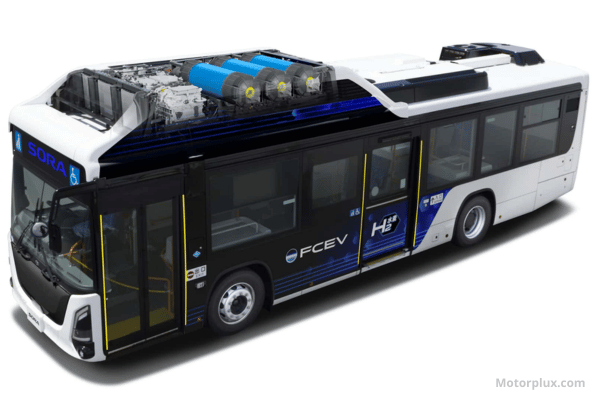
The model was jointly developed with Isuzu and combines the latter’s full-flat battery-electric bus platform with Toyota’s latest commercial fuel-cell technology. It replaces the first-generation Sora introduced in 2018 and represents the latest stage of Toyota’s long-running investment in hydrogen-powered mobility.
Although battery-electric buses have become an increasingly common choice for urban transit, hydrogen offers a different operating model. Fuel-cell vehicles can be refilled more quickly than most large batteries can be recharged, potentially making them attractive for routes where buses must remain in service for long periods.
More range from less hydrogen capacity
The new Sora can travel more than 300 kilometers under Toyota’s reference testing conditions. That represents an improvement of approximately 100 kilometers compared with the previous model, even though total hydrogen-tank capacity has been reduced by about 20 percent.
Toyota achieved the improvement by managing the relationship between the fuel-cell stack and a new large-capacity lithium-ion battery more efficiently. The battery can store energy and assist the fuel-cell system when operating conditions demand additional power, reducing unnecessary hydrogen consumption.
The bus carries three high-pressure hydrogen tanks operating at a nominal pressure of 70 MPa. Together, they provide 471 liters of internal tank volume.
A newly developed compact fuel-cell stack for commercial vehicles is mounted on the roof. Toyota says the unit provides greater output and durability while its positioning is intended to make maintenance easier for transit operators.
The stack produces a maximum of 113 kW. Propulsion comes from two AC induction motors, each rated at 110 kW and 485 Nm. Their combined maximum output is 220 kW, while total peak torque reaches 970 Nm.
Those figures are designed around the requirements of a large urban bus rather than outright speed. Immediate electric-motor torque should help the Sora move smoothly from stops, while the fuel-cell system generates electricity through an electrochemical reaction instead of burning hydrogen in a conventional engine.
Refueling takes approximately 10 minutes
Toyota estimates that the Sora can be completely refueled in about 10 minutes under suitable conditions. That is one of the model’s most important operational advantages.
Urban buses often cover long distances and return to service repeatedly throughout the day. A vehicle that can be refilled during a short scheduled break may require fewer changes to an operator’s established timetable than a bus that needs a prolonged charging session.
The Sora also complies with a new high-speed hydrogen filling standard. Toyota says future compatible stations could reduce refueling time by approximately half, potentially bringing a complete stop closer to five minutes.
These estimates will depend on the hydrogen station’s capacity, ambient temperature and other operating conditions. Fast refueling is also useful only where a reliable hydrogen supply and suitable station are available.
Infrastructure remains one of the largest challenges facing fuel-cell vehicles. A bus operator needs dependable access not only to a refueling station but also to hydrogen produced, delivered and stored at a commercially sustainable cost.
A common platform developed with Isuzu
The second-generation Sora is based on a full-flat electric route-bus platform created by Isuzu. Toyota then integrated its fuel-cell stack, hydrogen storage system and related control technology.
Sharing a platform between battery-electric and fuel-cell models can reduce development and component costs. It also gives transit operators more powertrain choices without requiring manufacturers to engineer an entirely separate bus for each energy source.
The cooperation reflects an important change in the commercial-vehicle industry. Instead of trying to use one technology for every route, manufacturers are increasingly developing several zero-emission solutions around common architectures.
Battery-electric buses can be particularly effective on predictable urban routes with sufficient depot-charging time. Hydrogen may offer advantages when vehicles need longer daily range, faster energy replenishment or high utilization. The most suitable option will depend on local electricity prices, hydrogen availability, route length, climate and depot infrastructure.
A flat floor improves passenger accessibility
Toyota and Isuzu used the new platform to create a completely flat passenger floor without internal steps. This should make movement through the cabin easier for older passengers, travelers carrying luggage, parents with strollers and people who use wheelchairs.
An optional one-touch wheelchair securement system is planned to become available for ordering around April 2027. The feature is intended to help the driver secure a wheelchair more efficiently while making boarding and disembarking more convenient for the passenger.
Toyota will offer four layouts: two intended for urban operation and two designed for suburban routes. The main urban specification measures 10,545 mm long, 2,485 mm wide and 3,440 mm high.
Its total stated capacity is 70 occupants, consisting of 19 seated passengers, 50 standing passengers and one crew member. That makes the Sora a full-size transit vehicle rather than a limited-capacity technology demonstration.
Improving accessibility is an important part of the model’s value. A zero-emission bus still needs to work as everyday public infrastructure, serving passengers with different levels of mobility safely and efficiently.
New systems monitor both the road and the driver
The Sora includes an Emergency Driver Stop System connected to a Driver Status Monitor. If the monitoring system detects that the driver may be experiencing a medical or physical problem, the bus can begin slowing down and bring itself to a stop.
After stopping, the system automatically engages the parking brake, including when the vehicle is positioned on a slope. The feature is intended to reduce the danger to passengers and other road users if the driver becomes unable to control the bus.
A front blind-spot monitor can also detect pedestrians and cyclists ahead of the vehicle and warn the driver. Visibility immediately around a large bus can be difficult, particularly on crowded city streets where vulnerable road users may pass close to the front corners.
These systems remain forms of driver assistance. They do not eliminate the need for professional training, attention or safe operating procedures, but they add another layer of protection around a vehicle that may carry dozens of passengers.
The Sora can provide electricity during emergencies
Like the previous model, the new Sora can serve a second purpose when it is not transporting passengers. Connecting an external power-supply unit allows the bus to deliver electricity during a disaster or power interruption.
That capability is particularly relevant in Japan, where earthquakes, severe storms and other emergencies can disrupt the electrical grid. A municipal fleet of fuel-cell buses could theoretically provide both transportation and temporary power support when normal infrastructure is unavailable.
This function also demonstrates one difference between a fuel-cell vehicle and a conventional diesel bus. The Sora is effectively a mobile electricity-generating system that carries its own hydrogen supply.
The value of emergency-power capability will depend on local planning and the availability of compatible external equipment, but it can strengthen the case for considering the bus as part of broader municipal-resilience planning.
Why Toyota continues investing in hydrogen
Toyota introduced the Mirai fuel-cell passenger car in 2014 and has since expanded its hydrogen work into trucks, buses, rail applications and stationary generators. By the end of September 2026, the company said it had supplied more than 3,500 fuel-cell systems to over 100 customers worldwide.
The company views hydrogen as one component of a broader carbon-neutral strategy rather than as a direct replacement for every battery-electric vehicle.
Public transportation is a logical area in which to test that strategy. Buses operate from managed depots, follow known routes and consume large amounts of energy on predictable schedules. Those characteristics can make centralized hydrogen infrastructure more realistic than it would be for thousands of individual private-car owners.
Hydrogen’s environmental benefit still depends heavily on how the fuel is produced. Hydrogen created using renewable electricity can have a much smaller carbon footprint than hydrogen derived from fossil fuels without effective emissions controls.
Efficiency is another consideration. Producing hydrogen, transporting it and converting it back into electricity normally involves more energy losses than charging a battery directly. The argument for fuel cells therefore rests on operational benefits such as range, payload, utilization and refueling speed.
A practical test for hydrogen-powered public transport
Toyota has not announced detailed international export plans for the new Sora. Its immediate importance lies in showing how hydrogen technology can evolve from an experimental concept into a more usable commercial vehicle.
The new version travels farther despite carrying less hydrogen, can be refilled in approximately 10 minutes and provides a flatter, more accessible passenger compartment. It also combines the expertise of two major Japanese manufacturers instead of relying on a completely independent platform.
None of that removes the infrastructure and energy-production challenges surrounding hydrogen. Transit agencies will still need to compare acquisition cost, fuel availability, maintenance, emissions and total operating expenses with battery-electric and conventional alternatives.
Nevertheless, the new Sora offers a clearer picture of where fuel cells may fit. Rather than attempting to compete with battery vehicles in every category, hydrogen may find its strongest role in heavily used commercial fleets that value rapid refueling and consistent daily range.
For Toyota, the Sora is therefore more than a new bus. It is a real-world test of whether hydrogen can earn a lasting place alongside batteries in the transition toward cleaner public transportation.