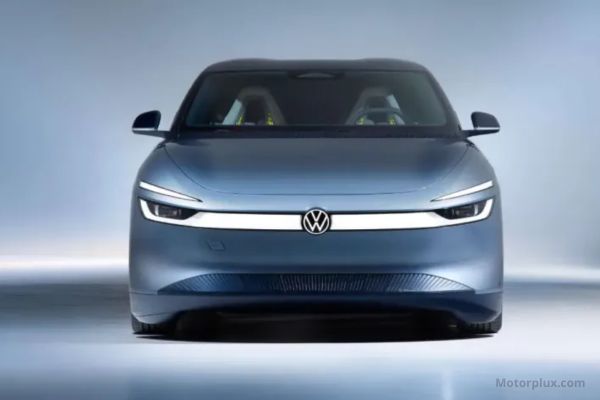
Volkswagen has unveiled a low, teardrop-shaped prototype that just quietly rewrote what’s possible for electric vehicle efficiency — and it did it using a motor, battery, and suspension components pulled directly from a production car already on sale. The Mission Efficiency, revealed in Wolfsburg, has been certified by Germany’s Record Institute with three separate world records covering aerodynamics, ideal-condition consumption, and real-world efficiency, and Volkswagen is positioning it as proof of what its existing small-car architecture can already achieve — not a distant, far-off fantasy.
The numbers, and why they matter
The headline figure is the car’s drag coefficient of just 0.158 — officially the lowest ever measured on a road-legal automobile, edging out every previous production or near-production vehicle to attempt the feat. Aerodynamic drag is one of the single biggest factors limiting an EV’s real-world range and efficiency, particularly at highway speeds, so a record this significant has implications well beyond bragging rights.
The second record came under tightly controlled “ideal trip” conditions: a constant speed of 68 km/h (42 mph), no uphill gradients, and auxiliary systems like the air conditioning switched off, yielding a consumption figure of just 6.48 kWh per 100 km. Volkswagen is upfront that this figure isn’t meant to represent everyday driving — it’s a best-case demonstration of the car’s theoretical ceiling.
The third record is the one with the most real-world relevance: a genuine, documented road trip of 1,278 kilometers (about 794 miles) from Wolfsburg to Vienna, traveling through Poland and the Czech Republic under normal driving conditions. Over that full journey, the Mission Efficiency averaged 6.89 kWh per 100 km excluding charging losses — or about 8.27 miles per kilowatt-hour, a figure that would translate to genuinely exceptional real-world range from a comparatively modest battery pack.
Built from parts you can already buy
What sets the Mission Efficiency apart from most efficiency-record prototypes is where its components actually came from. Rather than engineering a bespoke, low-volume powertrain purely to chase a record, Volkswagen built the car around hardware shared with the production ID. Polo and ID. Cross. The Mission Efficiency uses the same 99-kilowatt (135-horsepower) electric motor found in the standard ID. Polo, riding on the shared MEB+ front-wheel-drive platform that underpins both of those production models. Volkswagen has also confirmed the car shares front suspension components with the ID. Polo, along with a steering wheel borrowed from the same model.
The one meaningful upgrade is the battery: the Mission Efficiency carries 54.9 kWh of usable capacity, modestly larger than the 52 kWh pack in the standard ID. Polo, but nowhere near the oversized packs many manufacturers have used to chase headline range figures in recent years. That’s precisely Volkswagen’s point — the efficiency gains come almost entirely from aerodynamics and weight reduction, not from simply adding more battery.
Where the weight came off
To hit these numbers, Volkswagen made deliberate, visible trade-offs elsewhere in the car. Rear passenger space is limited to occupants around 1.60 meters tall or shorter, though the cabin was still designed with the idea that a young family of four could realistically use it. Inside, the car pairs a smaller instrument display with a third-party tablet rather than a fixed built-in touchscreen, uses manually adjusted seats made from recycled material instead of power-adjustable ones, and swaps a traditional sound system for a simple Bluetooth speaker. Every one of those choices strips out weight and complexity in service of the efficiency target, illustrating just how many small decisions compound into a record-setting result.
Beyond the basic shape and componentry, Volkswagen also built in some genuinely novel touches: a solar roof that supports the vehicle’s onboard electrical system, and patented rim deflectors designed to further smooth airflow around the wheels — a notoriously difficult area to optimize aerodynamically on any vehicle.
What it means for future EVs
Volkswagen has been explicit that the Mission Efficiency is a concept vehicle, not a car headed for production in this exact form. But the message behind it is squarely aimed at the rest of the EV industry, which has spent much of the past several years chasing efficiency and range primarily by making battery packs bigger — an approach that adds cost, weight, and raw material demand with every additional kilowatt-hour. Volkswagen’s counterargument, demonstrated concretely with parts pulled from a car already sitting in dealerships, is that meaningful gains in real-world range don’t necessarily require a bigger battery at all — they can come from aerodynamics, weight discipline, and smarter engineering applied to hardware that already exists. If that philosophy makes its way into future production vehicles, it could offer a genuinely different, potentially cheaper path toward longer-range EVs than the industry’s current default strategy of simply adding more cells.