America’s manufacturing rebuild has reached a striking milestone: announced private-sector manufacturing investment has now surpassed $2.07 trillion, according to the latest tracking from IndustrialSage, spanning 237 companies across 42 states and Puerto Rico. It’s a figure that reflects far more than a single industry or a single announcement — and automotive and clean-energy manufacturing are among the fastest-moving pieces of that broader rebuild, translating into new plants and expanded production capacity at a noticeably quicker pace than many other sectors.
A rebuild years in the making
The $2.07 trillion figure represents the cumulative total of major private manufacturing commitments tracked since 2025, and it spans a wide range of industries: semiconductors and advanced computing still lead the pack by dollar value, followed by aerospace, pharmaceuticals, critical materials, energy systems, and strategic manufacturing. But the automotive and EV manufacturing category has become one of the more significant contributors in its own right, with investment in that space tracking toward roughly $312 billion — a substantial slice of the broader total, and one with an unusually direct connection to jobs American communities can see and feel in the near term.
That distinction matters. Not every manufacturing dollar announced translates into a factory that opens quickly. Semiconductor fabs, for instance, often take the better part of a decade to reach full production. Automotive and clean-energy plants, by contrast, tend to move faster, frequently reaching meaningful hiring within just two to four years of breaking ground — which means the automotive share of this $2 trillion figure is more likely than most to show up as real jobs on a realistic timeline, rather than a promise that won’t materialize until the 2030s.
Why automotive is punching above its weight
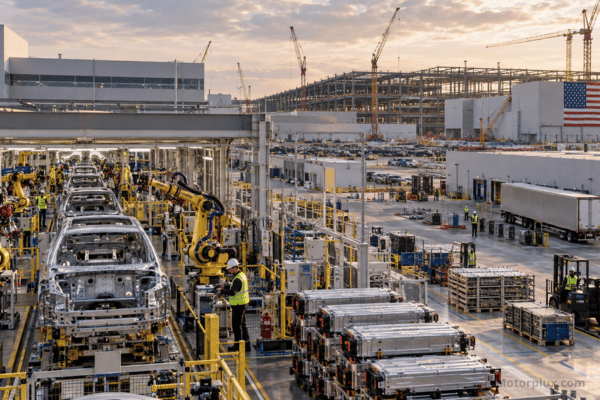
Part of what makes the automotive sector’s contribution notable is how it’s spread across the country rather than concentrated in one or two traditional manufacturing hubs. Recent months have brought major automotive investment announcements stretching from Texas to the Midwest to the Southeast, as automakers expand existing plants, retool facilities for new powertrains, and build out the battery supply chains needed to support next-generation vehicles. Battery manufacturing in particular has become a centerpiece of this buildout, with companies racing to establish domestic cell and pack production that reduces reliance on overseas suppliers — a shift that both strengthens supply chain resilience and creates a new category of skilled manufacturing jobs that didn’t widely exist in the US a decade ago.
The pace of investment in clean-energy manufacturing more broadly has also quintupled on a quarterly basis since 2022, according to tracking data, underscoring how quickly this corner of American industry has scaled up in just a few years. For an industry that spent much of the 2010s consolidating and, in some cases, shrinking its US manufacturing footprint, the current wave of expansion represents a genuine reversal.
The jobs question — and why the timing matters
Skeptics have reasonably pointed out that announced investment dollars and actual employment figures don’t always move in lockstep; broader manufacturing employment data has shown only modest net job growth even as investment announcements have piled up, since many of the largest projects — particularly in semiconductors — won’t hit their hiring peaks until 2027 through 2032. But this is precisely where automotive and clean-energy projects stand out from the pack: because they typically reach production and full hiring faster than heavy sectors like semiconductor fabrication, the jobs tied to automotive investment are more likely to show up on a timeline people can actually plan around, rather than a promise pushed out to the end of the decade.
What it means for the industry — and for shoppers
For the broader auto industry, this wave of domestic investment points toward a more resilient, more self-sufficient North American manufacturing base — one less exposed to the kind of overseas supply shocks that disrupted vehicle production during the pandemic-era chip shortage. For American workers, it means a growing pipeline of manufacturing jobs specifically tied to vehicles, batteries, and the broader EV supply chain, arriving on a faster timeline than the typical multi-year megaproject. And for consumers, more domestic production capacity — particularly in battery manufacturing — should eventually translate into steadier vehicle availability and less exposure to the kind of tariff-driven cost swings that have made headlines throughout 2026.
The $2 trillion milestone is, in one sense, just a running tally — a number that will keep climbing as more announcements roll in. But the automotive slice of that total tells a more concrete story: an industry that’s actively rebuilding its US manufacturing base, doing so faster than most other sectors, and creating jobs on a timeline that communities across the country are already starting to feel.