Among the many routine maintenance tasks that keep a vehicle running safely and efficiently, checking tire pressure stands out as one of the most straightforward — and most neglected. Drivers often assume that if a tire looks fine, it must be fine. That assumption, however, can lead to consequences ranging from reduced fuel economy to serious road accidents.
Why Tire Pressure Matters More Than You Think
Tires are the only point of contact between a vehicle and the road. When they are improperly inflated — whether overinflated or underinflated — the dynamics of that contact change in ways that affect everything from braking distance to handling stability.
Underinflated tires flex more than intended, generating excess heat and increasing rolling resistance. This accelerates tread wear, reduces fuel efficiency, and in extreme cases can lead to a blowout at highway speeds. Overinflated tires, on the other hand, make the vehicle ride harder, reduce traction, and cause uneven wear concentrated at the center of the tread.
Beyond performance and safety, proper tire pressure also has a direct impact on fuel consumption. A vehicle running on significantly underinflated tires can consume measurably more fuel per mile, adding unnecessary costs over time.
What You Need Before You Start
Checking tire pressure requires minimal equipment and takes only a few minutes. Before beginning, gather the following:
- A reliable tire pressure gauge — digital models offer the most accurate readings, though analog gauges work well when properly calibrated
- Your vehicle’s recommended tire pressure, found on a sticker inside the driver’s door jamb or in the owner’s manual — not the maximum pressure listed on the tire sidewall
- Access to an air compressor if inflation is needed
Step-by-Step: How to Check Tire Pressure Correctly
1. Check the Tires When Cold
Tire pressure readings are most accurate when the tires are cold — meaning the vehicle has been parked for at least three hours or driven fewer than a couple of miles. Driving heats the air inside the tire, temporarily raising the pressure and giving a misleading reading.
2. Remove the Valve Cap
Locate the valve stem on the inner rim of each wheel and unscrew the small cap. Keep it somewhere safe to avoid losing it.
3. Apply the Gauge Firmly
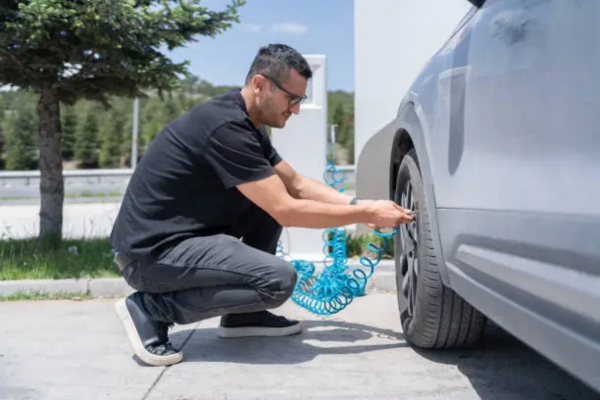
Press the tire pressure gauge straight onto the valve stem without tilting it. A slight hiss indicates air is escaping — reposition the gauge for a proper seal. The reading should appear within seconds.
4. Compare to the Recommended Level
Compare the measured pressure against the manufacturer’s recommended PSI (pounds per square inch). Note that front and rear tires may have different recommended values depending on the vehicle.
5. Inflate or Deflate as Needed
If a tire is low, add air in short bursts and recheck frequently. If overinflated, press the small pin inside the valve stem to release air gradually. Repeat until the pressure matches the specification.
6. Don’t Forget the Spare
The spare tire is often overlooked until it’s urgently needed. Make it part of your regular routine — a flat spare offers no help in an emergency.
How Often Should You Check?
Most automotive professionals recommend checking tire pressure at least once a month and before any long road trip. Temperature changes also affect pressure: as ambient temperature drops, tire pressure tends to decrease, making checks during seasonal transitions particularly important.
A Small Habit With a Big Return
Checking tire pressure takes less than five minutes and costs nothing beyond the initial investment in a quality gauge. Yet the benefits — improved safety, longer tire life, better fuel economy, and more predictable handling — make it one of the highest-value maintenance habits any driver can adopt. In automotive care, few actions deliver such a clear return for such minimal effort.