For more than a century, the automotive industry built its financial foundations on a straightforward premise: design a vehicle, manufacture it, sell it, and move on to the next model. Profit margins were dictated by steel costs, supply chains, and production volumes. Today, that model is being quietly but decisively dismantled — not by regulators or economic shocks, but by the industry’s own strategic pivot toward software.
Across the globe, major automakers are restructuring their revenue strategies around software-defined vehicles (SDVs), recurring subscription services, and over-the-air update capabilities. The question is no longer simply how many cars a manufacturer can sell, but how much value it can extract from a vehicle throughout its entire lifespan.
Why Hardware Margins Are Under Pressure
The traditional automotive hardware business has become increasingly difficult to protect. Rising raw material costs, electrification investments, stricter emissions regulations, and intensifying competition — particularly from Chinese manufacturers — have compressed profit margins on physical vehicles significantly. Building and selling a car has never been more expensive, and consumers remain sensitive to pricing.
Electric vehicles, while representing the industry’s future, have historically carried thinner hardware margins than their combustion counterparts, largely due to battery costs and the infrastructure required to support the transition. This financial reality has accelerated the search for alternative revenue streams.
Software, by contrast, offers something hardware rarely can: scalability without proportional cost increases. Once a software platform is developed and deployed, it can be monetized repeatedly across an entire fleet with minimal incremental expense.
The Subscription Economy Enters the Garage
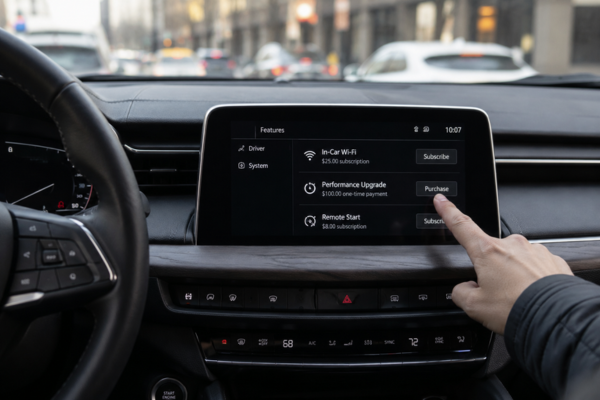
Automakers are increasingly adopting revenue models borrowed from the technology sector. Features such as advanced driver assistance systems, enhanced connectivity packages, remote access capabilities, and even performance upgrades are being offered as subscription-based services — activated digitally rather than installed physically at purchase.
This approach fundamentally changes the economic relationship between manufacturer and customer. A vehicle sold today can generate revenue for years after leaving the dealership floor, through renewals, upgrades, and new feature unlocks. For automakers, this creates a more predictable and diversified income stream that is far less vulnerable to cyclical vehicle sales fluctuations.
Data services represent another growing layer. Connected vehicles generate substantial volumes of operational and behavioral data, which can inform insurance partnerships, fleet management solutions, and urban mobility planning — all potential revenue channels that did not exist in the traditional hardware-centric model.
Building the Infrastructure for a Software Future
Making this transition is not simply a matter of adding connectivity features to existing vehicles. It requires a fundamental rethinking of vehicle architecture. Leading manufacturers are investing heavily in centralized computing platforms that consolidate vehicle functions under unified operating systems, replacing the fragmented network of independent electronic control units that have defined automotive engineering for decades.
This architectural shift enables faster software deployment, easier updates, and a more cohesive digital experience — but it also demands capabilities that most traditional automakers are still developing. Many have responded by forming partnerships with technology firms, acquiring software talent, and establishing dedicated software divisions as standalone business units.
Challenges That Cannot Be Ignored
The pivot to software revenue is not without significant obstacles. Consumer acceptance of subscription models for features considered standard has proven inconsistent, with some early implementations drawing public criticism. Cybersecurity concerns grow alongside connectivity ambitions, and regulatory frameworks around data ownership and digital services vary considerably across markets.
There is also the challenge of execution. Writing reliable, scalable automotive software is a discipline that differs substantially from hardware engineering, and the industry is still maturing its competency in this area.
The Road Ahead
Despite these challenges, the strategic direction is clear. The automakers most likely to lead the next decade will be those that successfully evolve from pure vehicle manufacturers into technology and mobility service platforms. Hardware will remain essential — a car must still be a car — but the competitive and financial advantage will increasingly reside in the software layer that brings it to life.