The rollout of 5G networks is no longer a distant promise confined to consumer smartphones and urban infrastructure. It is rapidly becoming a foundational layer for the next generation of automotive technology, reshaping what vehicles are capable of — not just in terms of entertainment, but in safety, navigation, communication, and autonomous driving support.
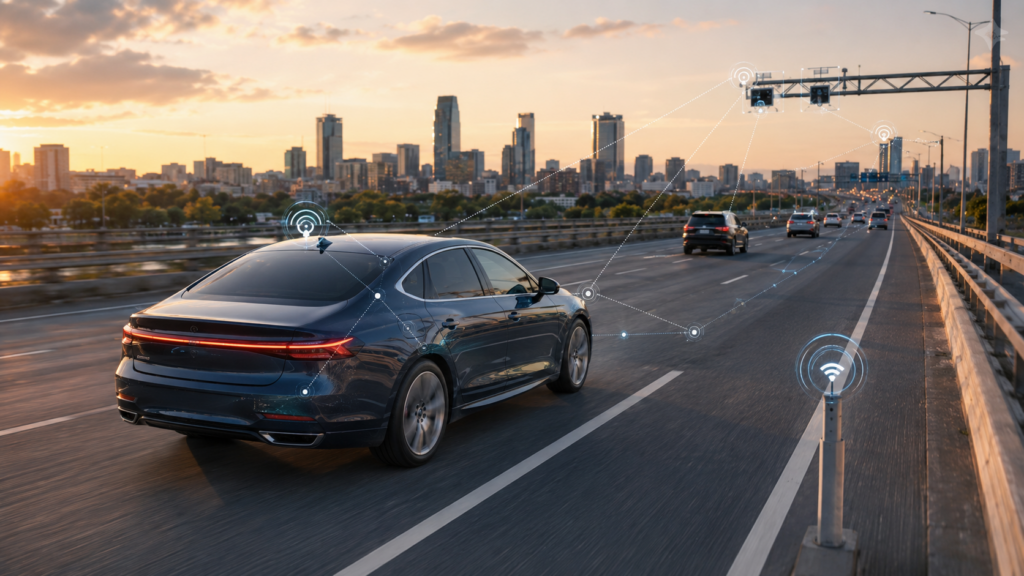
As automakers and technology providers deepen their investment in connected vehicle platforms, 5G is emerging as the critical enabler that previous network generations simply could not deliver at the required speed or reliability.
Why 5G Changes the Equation
Earlier wireless standards — including 4G LTE — brought meaningful improvements to in-car connectivity, enabling over-the-air software updates and basic real-time navigation data. However, the demands of modern vehicles have quickly outpaced those capabilities.
5G offers dramatically lower latency, far greater bandwidth, and the ability to handle massive volumes of simultaneous data streams. For a vehicle that may be processing sensor inputs, communicating with road infrastructure, streaming high-definition content for passengers, and receiving software patches — all at the same time — these improvements are not incremental. They are transformative.
- Ultra-low latency: 5G can reduce communication delays to near-real-time levels, which is essential for safety-critical applications such as collision avoidance and vehicle-to-vehicle (V2V) communication.
- Higher bandwidth: Supports richer in-cabin experiences, including high-resolution maps, live traffic data, and cloud-based driver assistance features.
- Network slicing: Allows different types of data — safety alerts, entertainment, navigation — to travel across dedicated virtual channels with guaranteed performance.
Vehicle-to-Everything Communication
One of the most significant applications of 5G in automotive contexts is Vehicle-to-Everything (V2X) communication. This technology allows a car to exchange data not only with other vehicles but also with traffic signals, roadside sensors, pedestrian devices, and centralized traffic management systems.
The practical implications are substantial. A 5G-connected vehicle could receive a warning about a stopped car around a blind corner before any driver could visually detect it. It could anticipate green light windows to optimize fuel or energy efficiency, or coordinate with emergency vehicles approaching an intersection — all in fractions of a second.
This level of responsiveness moves vehicles from isolated machines to active participants in a broader, intelligent transportation ecosystem.
Software-Defined Vehicles and Over-the-Air Updates
5G also accelerates the evolution of software-defined vehicles — cars whose core capabilities are increasingly determined by software rather than fixed hardware. With faster and more reliable connectivity, manufacturers can push meaningful updates to a vehicle’s operating systems, driver-assistance features, and even powertrain management without requiring a dealership visit.
This model not only reduces maintenance friction for consumers but also allows automakers to continuously improve their products after purchase, responding to regulatory changes, safety discoveries, or consumer feedback with greater agility than the traditional manufacturing cycle would ever permit.
In-Cabin Experience and Passenger Connectivity
Beyond the mechanical and safety dimensions, 5G is redefining the cabin as a connected living space. As autonomous and semi-autonomous driving features reduce the attention demands placed on drivers, passengers — and eventually drivers themselves — are expected to consume more digital content, participate in video calls, and engage with cloud-based productivity tools while in motion.
5G’s bandwidth capacity supports this shift without the buffering and connectivity drops that have historically frustrated users relying on in-car Wi-Fi or mobile hotspots.
The Road Ahead
The full potential of 5G in automotive applications will depend on the continued expansion of network infrastructure, standardization of V2X communication protocols, and close collaboration between automakers, technology firms, and telecommunications providers. Regulatory frameworks will also play a decisive role in how quickly these capabilities reach consumers at scale.
What is already clear, however, is that 5G is not simply adding speed to an existing system. It is fundamentally rewriting the relationship between vehicles and the world around them — turning every journey into a data-rich, dynamically connected experience that previous generations of drivers could not have imagined.