Advanced Driver Assistance Systems — commonly known as ADAS — have evolved from simple cruise control mechanisms into sophisticated, layered safety architectures capable of interpreting the world around a vehicle in real time. Today’s systems represent a convergence of hardware, software, and artificial intelligence that is fundamentally changing the driving experience.
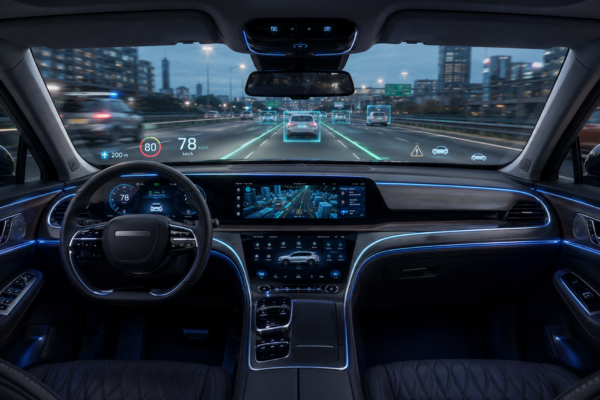
Understanding what powers these systems helps drivers make more informed decisions about the vehicles they choose, and helps the broader public appreciate the engineering effort behind features that are quickly becoming standard across the industry.
The Sensor Layer: Eyes and Ears of the Vehicle
At the foundation of any ADAS platform is a suite of sensors designed to detect, measure, and interpret the vehicle’s surroundings. These typically include:
- Radar: Highly effective at measuring the speed and distance of surrounding objects, radar performs reliably in adverse weather conditions such as rain or fog, making it a cornerstone of collision warning and adaptive cruise control systems.
- Cameras: Optical cameras provide the system with visual data — lane markings, traffic signs, pedestrians, and other vehicles. They are essential for lane departure warnings, traffic sign recognition, and driver monitoring.
- Ultrasonic sensors: Positioned around the vehicle’s perimeter, these short-range sensors are primarily used for parking assistance and low-speed maneuvering alerts.
- LiDAR: While still more common in autonomous development platforms than in mass-market vehicles, LiDAR generates precise three-dimensional maps of the environment by emitting and measuring reflected laser pulses.
Most modern ADAS-equipped vehicles rely on a combination of these technologies rather than a single sensor type, creating redundancy that improves reliability and safety margins.
The Intelligence Layer: Processing What the Sensors Capture
Raw sensor data is only as useful as the system’s ability to interpret it quickly and accurately. This is where onboard computing power and artificial intelligence play a decisive role.
Dedicated electronic control units — often referred to as domain controllers or central compute modules — receive continuous data streams from the sensor array and process them in milliseconds. Machine learning algorithms trained on vast datasets allow these systems to classify objects, predict movement patterns, and make decisions that trigger vehicle responses such as automatic braking, steering corrections, or alerts to the driver.
The shift toward software-defined vehicle architectures has accelerated this process. Automakers are increasingly designing vehicles with centralized compute platforms that can be updated over the air, meaning ADAS capabilities can be improved or expanded long after a vehicle leaves the factory floor.
From Passive Alerts to Active Intervention
One of the clearest indicators of ADAS maturity is the transition from warning-based features to active intervention systems. Early implementations would alert a driver to a potential lane departure or forward obstacle. Contemporary systems go further — automatically applying brakes, adjusting steering input, or managing speed to mitigate risk before the driver has had time to react.
Features such as Automatic Emergency Braking (AEB), Lane Centering Assistance, and Blind Spot Monitoring with active steering support represent this new generation of proactive safety technology. Regulatory bodies in major markets have begun mandating several of these features across new vehicle lineups, signaling their transition from premium extras to industry baseline standards.
The Road Ahead
ADAS technology is not static. The industry continues to push capabilities further, with an eye toward higher levels of driving automation. Sensor resolution is improving, computing platforms are becoming more energy-efficient, and the integration of vehicle-to-infrastructure communication promises to extend situational awareness beyond what onboard sensors alone can provide.
For drivers today, these systems represent a meaningful layer of protection — not a replacement for attentive driving, but a capable co-pilot designed to fill the gaps that human reaction time cannot always cover. As the technology matures, the relationship between driver and vehicle will continue to evolve in ways that prioritize safety, efficiency, and confidence on the road.